Notes on “The Origin of the Human Spirit in Early Mormon Thought”, by Van Hale

Source: Bergera, Gary James. Line Upon Line: Essays on Mormon Doctrine. Signature Books, 1989. Archived online copy. Google Books link. Kindle link.

  • Most Mormons accept the idea that “we came from a premortal existence where our spirits were literally begotten by a heavenly father and a heavenly mother.” (115)
    • “Closely related is the belief that the resurrected faithful of this earth will do what God has been doing: procreate spirit children for future worlds.” (115)
  • The doctrine clearly did not originate in scripture.” (116)
    • No explicit statements in the church’s four standard works (Bible, Book of Mormon, Doctrine and Covenants, Pearl of Great Price) support the spirit birth doctrine.” (115)
    • Cited to support the idea, Hale concedes that verses like Acts 17:28, Galatians 4:4-7, Romans 8:16, Hebrews 12:9 “do not state that God procreated our spirits, and while a premortal spirit birth may be inferred by the terms ‘Father,’ ‘sons,’ and ‘offspring,’ the more likely intent of these biblical authors is that God is the father of those who accept the gospel and are adopted as his spiritual children.”
      • [Hale miscategorizes at least Acts 17:28, which, though not about premortal spirit birth, neither is it about redemptive sonship. It instead speaks of God as the special creator of humans.]
      • D&C 76:24 “does not refer to the idea of literal procreation by God”, but about “begotten sons and daughters unto God through Jesus Christ.”
  • Late Nauvoo theology ∉ early LDS scripture
    • “Most LDS scripture was produced while Mormon theology was in its infancy, and there is little in LDS canon from the theologically productive Nauvoo, Illinois, period of the early to mid-1840s.” (116)
  • Despite extensive Mormon literature from this period, none of Joseph Smith’s recorded sermons explicitly teach spirit procreation.
  • “Smith’s own doctrinal teaching was that the human spirit as a conscious entity is eternal—as eternal as God.” (p. 116)
  • “Smith used the terms ‘spirit,’ ‘soul,’ ‘intelligence,’ and ‘mind’ synonymously to describe the inchoate, indestructible essence of life.” (p. 116)
  • Eight documentary sources (from 6 May 1833 to 7 April 1844)
    • D&C 93:29 (1833): “Man was also in the beginning with God. Intelligence, or the light of truth, was not created or made, neither indeed can be.”
    • Willard Richards (c. 1839-1841): “The Spirit of Man is not a created being; it existed from Eternity & will exist to eternity.”
    • Joseph Smith (February 6, 1840): “I believe that the soul is eternal; and had no beginning; it can have no end… . the soul of man, the spirit, had existed from eternity in the bosom of Divinity.”
    • Joseph Smith (January 5, 1841): “If the soul of man had a beginning it will surely have an end… . Spirits are eternal.”
    • Joseph Smith (March 28, 1841): “The spirit or the inteligence of men are self Existant principles before the foundation [of] this Earth.”
    • Book of Abraham 3:18, 22-23 (1842): “If there be two spirits, and one shall be more intelligent than the other, yet these two spirits, notwithstanding one is more intelligent than the other, have no beginning; they existed before, they shall have no end, they shall exist after, for they are gnolaum, or eternal. 22. Now the Lord had shown unto me, Abraham, the intelligences that were organized before the world was; and among all these there were many of the noble and great ones…”
    • George Laub (1845, summarizing Smith sermon dated April 6, 1843): “How came Spirits? Why, they are and ware Self Existing as all eternity & our Spirits are as Eternal as the very God is himself…”
    • King Follett discourse (April 7, 1844)
  • Early formation
    • Lorenzo Snow and Orson Pratt promoted the spirit birth doctrine during Smith’s lifetime.
    • Published in the church’s official organ, Times and Seasons, and through sermons by apostles and Eliza R. Snow.
    • Orson Pratt’s Prophetic Almanac (1845): Introduced a catechism stating that humans are the offspring of God, implying literal spirit begetting.
    • Phelps
    • Eliza R. Snow’s “My Father in Heaven” (1845): References a mother in heaven and spirit birth, indicating these concepts were embraced post-Smith.
  • Two main theories:
    • 1. Spirits formed from eternal, unorganized spirit matter through spirit birth.
      • Suggests spirits can have a beginning and potentially cease to exist, which conflicts with Smith’s view of eternal spirits.
    • 2. Individual intelligences are eternal and uncreated; spirit bodies are created through procreation by heavenly parents.
      • Supported by B. H. Roberts and others, though it diverges from Smith’s original teachings.
    • Both theories attempt to align Smith’s eternal spirit doctrine with the later spirit birth belief.
  • Brigham Young
    • Taught that God and exalted beings are literal progenitors of both physical and spirit children.
      • First physical bodies on each world are begotten by the world’s god.
    • Reinforced the spirit birth doctrine, aligning it with the belief in eternal progression and exaltation.
  • B. H. Roberts posited that the intelligences are eternal and uncreated, and that spirit bodies are procreated by divine beings
    • John A. Widtsoe adopted Roberts’ view, affirming the eternal nature of intelligence and supporting the idea of procreated spirit bodies
    • James E. Talmage
    • Joseph Fielding Smith
  • The spirit birth doctrine is widely taught by Mormon leaders but contradicts Joseph Smith’s recorded teachings.
    • According to Hale, it likely emerged from early followers’ interpretations or unrecorded teachings rather than directly from Smith.

See also

Peter Sammons on the Timeless Love of God

Human relationships are always influenced by time and space, yet they are never hindered by those limitations. When two people are speaking in person, for example, they hear each other’s words after those words are spoken, and each is communicating at different temporal rates. Yet, the conversation is still intelligible and meaningful to both parties.

Beyond that, consider a conversation broadcast over video: Each participant hears and sees the other not only speaking at different times but also from completely different locations. Yet, their relationship is not considered disingenuous. Humans don’t need to be in the same space, or connect at the same time, in order for there to be a meaningful relationship. In the same way, it seems to make little sense to think that God’s relationships with humans are anything less than authentic simply because they do not occupy the same time-space.

Those who claim that God’s relationships are less real because He is atemporal simply do not understand the wonderful significance of God’s eternality on His relationships.

By way of contrast, consider your own earthly relationships. When you have a newborn girl, you can experience and love her while she is in that needy state in a way you simply cannot when she becomes an independent adult. Similarly, when you grow old, your relationships to your siblings will be different than when you were children. This is because your relationships change based on the various temporal intervals of your earthly life.

Your relationships are limited and subject to change. They grow stronger and weaker in intimacy with the passage of time, distance, and communication. But when we consider God’s relationships with temporal creatures, we need to remember He possesses all His life at once. Thus, God has all of your life with Him at once. He can relate to us in fullness at once. He can be closer and more intimate with a temporal creature than two time-bound creatures ever could with each other. Since His relationships are not determined or affected by the fleeting moments of life, He does not possess the limitations in relationships that temporal creatures experience.

Thus, God has all of your life before Him each time you kneel in prayer. He can relate to you in a more real manner than you can relate to yourself—in complete fullness. He can be closer and more intimate with a temporal creature than a time-bound creature could ever hope to be. Your spouse can only relate to who you are in this moment, but God looks chronologically before and after you and can love you in the entirety of your being—past, present, and future.

The concern is that a genuine relationship is nullified between a time-bound creature and a time-less God. But this is simply not true. God always acts in time—He is the author of time, the governor of time, and has relationships with His creatures who are bound by time. Every decree of the Lord is executed in time. But God does not undergo temporal succession, even though the works of His hands are very much in time and space. The actions and relationships of the Lord are a product of His eternal will—His eternal will exists outside of time, and then it breathes numerous temporal effects into being.

In the end, those who claim that God’s relationships are less real because He is atemporal simply do not understand the depth of God’s relationships as an eternal being. As mentioned earlier, human relationships evolve based on the various temporal seasons of earthly life. Your relationships are limited by, and subject to, change. They grow stronger and weaker in intimacy with the passage of time, distance, and communication. They wane and are complicated by years and moves. But it is not so with God.

Sammons, Peter. The Forgotten Attributes of God: God’s Nature and Why it Matters (The Institute for the Christian Life Series) (pp. 124-126). CLC Publications. Kindle Edition.

Good news: God isn’t like us

Christian evangelists to Mormons have a long tradition of proclaiming Isaiah 43:10, 44:6, and 44:8:

  • “Before me no god was formed, nor shall there be any after me.”
  • “I am the first and I am the last; besides me there is no god.”
  • “Is there a God besides me? There is no Rock; I know not any.”

This is a glorious proclamation. May it continue.

Two pieces of advice for my evangelistic friends.

1. Stack this up with yet more of Isaiah 40-48

  • He never learned (40:13-14).
  • He can’t be likened to another (40:18)
  • He alone stretched out the heavens and the earth (44:24).
  • His understanding is unsearchable (40:28).
  • He won’t share his glory with another (42:8).
  • He has no equal (46:5).
  • He declares the end from the beginning (46:10).

The spirit of monotheism isn’t merely to worship one God. It is also to acknowledge that he is uniquely worthy of worship. It is to worship him alone because he is exclusively worthy of worship. He alone can be described with the above attributes.

One way of saying this is: he alone is properly called God. “I am God, and there is no other” (Isaiah 46:9).

Another way of saying this: any other “gods” are inferior to him, subordinate to him, created by him, and should worship him. “Bow down to him, all gods” (Deuteronomy 32:43). “You are exalted far above all gods” (Psalm 97:9).

These are two semantic sides of the same conceptual coin. Including other beings in the linguistic domain of “gods” doesn’t put them in the exclusive and unique category that God himself describes.

And to smuggle in radical diminutives, e.g. “for us”, or “as far as we’re concerned”, or “as far as we know”, is sadly to miss the point.

2. Note how God presents his supremacy alongside his gentle shepherding.

His transcendence is the basis for his love and friendship and encouragement:

  • “He will tend his flock like a shepherd; he will gather the lambs in his arms; he will carry them in his bosom, and gently lead those that are with young.” (40:11)
  • “Fear not, for I am with you; be not dismayed, for I am your God.” (41:10)
  • “For I, the LORD your God, hold your right hand.” (41:13)
  • “I am the one who helps you.” (41:14)
  • “Even to your old age I am he, and to gray hairs I will carry you.” (46:4)

The big takeaway

It’s good news that God isn’t like us.

It is this God that can save us.


If you’re thinking, “too long, didn’t read”, then start here:

Combine Isaiah 43:10 (“Before me no god was formed”) with:

  • 40:14 (“Who… taught him knowledge?”)
  • 40:11 (“He will tend his flock like a shepherd.”)

The Rise and Strength of Mormonism, by S. E. Wishard D.D.

Source: The Evangelist, December 28, 1899, p. 17. Link.


The rise of the Mormon Church took place in the early part of the century, at the time of the great religious awakening. The young man, Smith, who afterwards claimed the gifts of a prophet, spent his boyhood in idleness. The story of his book of Mormon is familiar history. The work is a tissue of most improbable and contradictory statements, interlarded with quotations from the Bible, sometimes whole chapters. It was undoubtedly the work of Sydney Rigdon, who had been a minister in the Christian Church.

Following the issuance of the book of Mormon, on the title page of which Joseph Smith was announced as “Author and proprietor,” the Mormon Church was organized, April 6, 1830. Though making extravagant claims, its organization was at first very simple.

The whole enterprise was, however, conceived in falsehood and developed in fraud. Many of the early members left the church in disgust, or were cut off from it because of their attempt to correct certain vices which had become a part of the organization.

Yet the strength and development of Mormonism may be readily accounted for. The doctrine of “Continuous Revelation” is the taproot of the whole system. From this source is drawn the authority to make any changes in the system which the exigency may make necessary. Once concede that such a man as Joseph Smith or Brigham Young is “The Prophet, Seer and Revelator;” that he is “the mouth-piece of God;” that he speaks with divine authority; that, as Mr. Roberts says, “he is in reality a part of God,” and the foundation is laid for this stupendous system.

The development of this doctrine of “Continuous Revelation” has subjugated the entire people of the Mormon Church to the will of one man, or at most to the will of that man and his two counselors.

Did Joseph want a luxurious home for himself? He only needed to get a “thus saith Lord,” ordering certain brethren of the church to form a joint stock company and build the house “for my servant Joseph and his posterity forever.” That revelation came in such precise terms as to mention the names of the men thus commanded of the Lord.

Did he wish to clothe himself with divine authority to command the people and “lord it over God’s heritage?” He had no difficulty in getting a revelation instituting the order of the priesthood and clothing it with the power that belongs to God.

When it was discovered in the church that he had fallen into licentious practices, imperilling his character and position, and threatening the disruption of his family and the church, he again had recourse to revelation. True, the book of Mormon, of which he announced himself “the author and proprietor,” three times denounced polygamy and concubinage as abominable and sinful, yet he found no difficulty in getting a revelation from the Mormon God (who is Adam), both approving and authorizing polygamy. Why not? According to further revelation God is a progressive being. He is constantly gaining information. He is learning new things, and what was wrong and “abominable” for David and Solomon he has now discovered to be right for Joseph and Brigham.

In this doctrine of “continuous revelation” lie the germs of all the power of the Mormon Church. This doctrine has furnished designing men authority to construct one of the most thoroughly organized and compacted pieces of ecclesiastical machinery the world has ever seen.

It has adopted a religion suited to every demand of depraved human nature, a religion calculated to sweep into its folds the vicious, the ignorant, the superstitious—every man who wants a religion that will allow him full liberty to live according to his lusts. Mormonism is a mixture of Buddhism, of Mohammedanism, Confucianism, Paganism, Jesuitism, old Judaism. It teaches the doctrine of salvation by merit as thoroughly as Buddhism. The fleshly lusts of Mohammedanism foul the system. It teaches ancestral worship as does Confucianism. The polytheism of the pagans runs through it. The chicanery of Jesuitism has marked its course. It repeats the ceremonies of old Judaism in many things—burdened with rites, ceremonies, and oaths.

The aims of this ecclesiastical immorality are only equaled by its assumptions. This nondescript is masquerading before the world as the only true religion, claiming the right to overthrow all governments, to make constitutions, appoint kings, presidents and all rulers.

Where is its power? In the assumption that it is continually receiving revelations—that God is in and back of its organization, that he is the author of all its dicta. Human responsibility among the masses is at an end. It has been handed over to a priesthood clothed with divine wisdom and power and assumes to be acting for God, as God and “is God.”

The numerical strength of the Mormon Church is not certainly known. It is probably between 250,000 and 300,000. It comprises about three-fourths of the population of Utah, and holds the balance of power in Idaho and Wyoming. It is rapidly colonizing in Arizona, New Mexico and Nevada, and confidently expects to dictate terms to the politicians of that region. The church is counting on determining who shall be the twelve senators from those six states when New Mexico and Arizona come into the Union.

The Christian Churches have a large duty to perform to these deluded people. They should inform themselves therefore concerning conditions in Utah, and courageously meet the exigencies of the hour.

A Tract Society Colporter in Utah

Source: The Evangelist, October 26, 1899, p. 8. Link.


Somewhat over a year ago, an appeal was made by the American Tract Society for special aid in behalf of its colportage work in Utah. In response to that appeal, several Christian Endeavor Societies united in furnishing the funds necessary for the equipment of a Gospel colportage wagon. Other help was generously given, and the result of this united effort is thus expressed in the last annual letter of our valued colporter, Mr. George D. Peacock.

George D. Peacock

“The colportage wagon, which is fitted out with mattress, cooking apparatus, and utensils, tent and such other conveniences as go to make up a first-class traveling equipage, will greatly facilitate carrying on our work. Heretofore much of my work has been along railroad lines, and I have been greatly hampered for lack of facilities for reaching the ‘out-of-the-way places.'”

By means of the colportage wagon, Mr. Peacock has traveled hither and thither, scattering tracts, leaflets, and books, and preaching the word of truth wherever opportunity has offered. Meantime he has been busy with the camera, and the accompanying pictures are but a few of many that have been taken to illustrate his work for the Tract Society.

Gospel Colportage Wagon

As to his methods Mr. Peacock writes:

“Until within the last six months, my work has been along railroad and stage coach lines and places easy of access. The same is true of all missionaries at work in Utah, which means that a large percentage of the people living in remote parts have not Gospel privileges nor have they been supplied with Bibles and Christian literature.

“I opened my first campaign with the new colportage equipage the first of last May, in company with the Rev. Dr. Wishard, the Rev. E. S. Anderson, and the Rev. G. W. Martin.

Our Gospel party set out from Salina, Utah, on a bright May morning, and as we had planned to open our campaign at St. George, Utah, a distance of two hundred and fifty miles, had to be covered. I think words are inadequate to describe the wild, barren and isolated regions through which one travels en route to the ‘Dixie of Utah.’ The St. George road traverses a few productive valleys, then over that great Tushar range whose summit towers up twelve thousand feet above sea level, through the narrows of Clear Creek Cañon, with perpendicular cliffs a thousand feet high on either side, then over a dreary desert waste, and at last over a volcanic range, from whose summit a rapid descent of thirty-three hundred feet in a distance of four miles, brings us to St. George.

“In two days our tent is pitched and seated and everything ready for a series of meetings to last through five weeks. By this time, our plan was discovered by the Mormon officials and we were written up in an editorial in the Deseret News (the church organ). We were soon followed by the First Presidency and some other officials of the Mormon Church, who came down to Southern Utah, to keep their brethren from ‘going astray,’ as they called it. They did not hamper our work, however. Our tent meetings were a success beyond all expectation. Great crowds came night after night, and joined heartily in the singing of Gospel hymns.

“I went on day after day, with my house-to-house visitation, everywhere distributing tracts and bound volumes, praying with the people, and encouraging them to continue in attendance at the meetings.

“I had been through Southern Utah on a colportage tour in the autumn of 1897. St. George was not a strange place to me, and many of the people remembered me, giving assurance that the good books distributed before had influenced them for good.

“Southern Utah, south of the ‘great basin rim,’ has an elevation of twenty-seven hundred feet, and is extremely hot, dry, and sandy; the valleys are narrow and deep; perpendicular walls of red sandstone and black basaltic rock rise up to great heights on every hand. Extinct volcanoes are numerous, and the cragged lava ridges run in every direction.

“The water is highly impregnated with minerals; the supply very inadequate for irrigation. It is amazing how people find a subsistence in such a country. Extreme poverty, ignorance, and immorality are very prevalent. Wine-drinking is indulged in to an appalling degree. Dancing, card-playing, and cigarette-smoking are the favorite ‘pastimes.’

“The first of last July found me in Parowan, Iron County. I left there on the morning of July 4 for Salina, Sevier County. The distance is one hundred and twenty miles, and I was three days on the road.

“One hundred miles of my route lay right along the west bank of the Sevier River. This river traverses several fertile valleys, separated now and then by chains of mountains, through which the Sevier River has cut deep cañons, whose precipitous walls on either side were several hundred feet high.

“There are a great many ranches and several little villages interspersed throughout the whole extent of the Sevier Valley. The people occupying these villages and ranches are nearly all Mormons. They are very illiterate and superstitious, as well as indolent and negligent in all their domestic affairs. They have but little money, and still less of the comforts of life. One does not have to ask these people if they are educated, if they like books, and if they love the flag. Their very houses—houses, for they cannot be called homes—and their surroundings, are sure indications of their condition.

“I visited many of these ranches. Many of the people were entirely without religious reading, and but few of them had even a Bible or a piece of a Bible.

“Such is the country and such is the condition of the people through Southern and Eastern Utah. Blessed work that will carry the Gospel in the ‘printed page,’ into these homes, that it may remain there permanently to accomplish that whereunto it has been sent!”

Since writing the above, Mr. Peacock has been actively engaged in the work of distributing Christian literature through Utah.

From The Messenger, courtesy American Tract Society.

The Evangelist (September 28, 1899, pp. 2, 10)

An Appeal to Every True Presbyterian Interested in Higher Christian Education

The Sheldon Jackson College
Salt Lake City, Utah

Solicits the aid of the entire Presbyterian Church in the U.S. of America, and proposes a novel plan for raising $250,000 and giving the donors full and valuable return for these subscriptions in home building sites in Salt Lake City.

Like “Bread cast upon the waters,” your charity is likely to return a hundredfold.

We want all true Presbyterians to give us not only their prayers and moral support but their financial assistance to build this College and aid in rooting out Mormonism, which all Presbyterians must feel is a menace to our Church in Utah, besides being a blot on the bright escutcheon of our enlightened civilization.

There is no place in the country where Presbyterian money will accomplish more for Christian education, by counterbalancing false religion, and giving Christian training to those who will eventually be controlling citizens in a half a dozen States, than by PLANTING A CHRISTIAN COLLEGE AT SALT LAKE CITY.

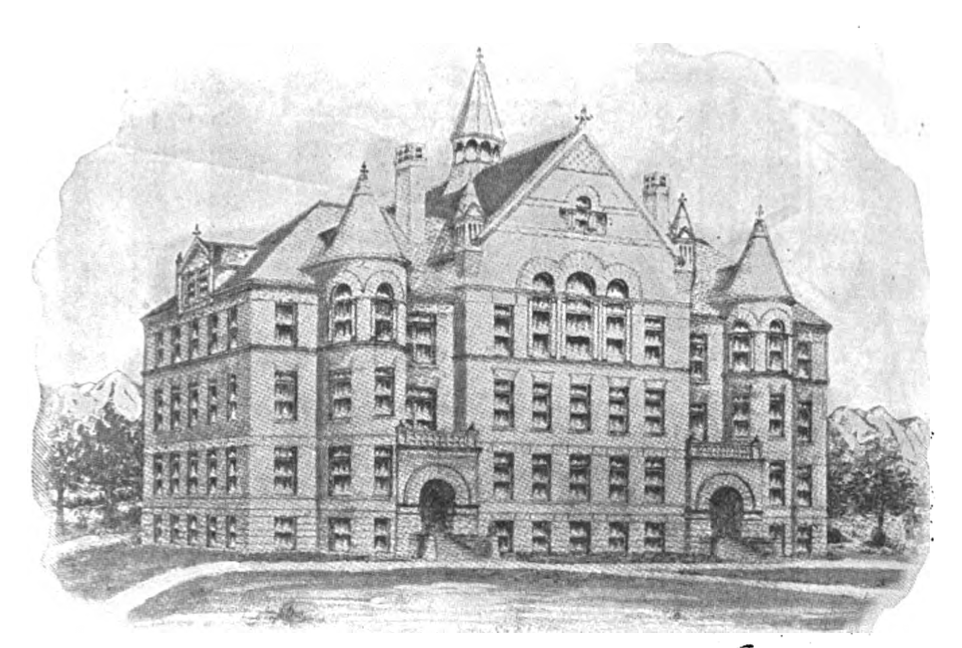
A Presbyterian College has already been planted here with the approbation of the General Assembly. That College, however, is more in name than reality. While it has its Faculty, and its first class almost ready to graduate, it has no college building. In order to make permanent the mission and educational work of our Church in Utah during the past, a complete Christian College outfit is an imperative necessity. The thousands of young men and women we have taken through the preparatory schools and academies of Utah, must either stop their studies at this point or be turned over to Mormon universities and to the immoral influence of the Mormon Church from which we have rescued them.

We Can and Must Rally Our Own People to the Work that God Has Laid Before Us and Prevent This Calamity.

The Proposed Sheldon Jackson Presbyterian College at Salt Lake City Utah

Officers:
General John Eaton, LL.D., President
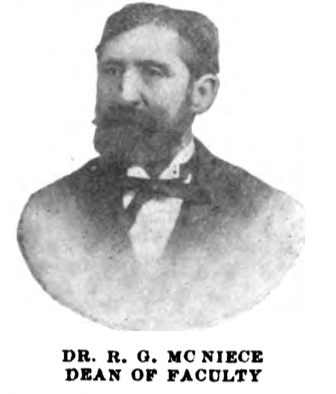
Robert G. McNiece, D.D., Dean of Faculty
Rev. Josiah McClain, Secretary
Gull S. Peyton, Treasurer

Trustees of the College:
Rev. S. E. Wishard, D.D., Rev. Geo. W. Martin, Seth H. T. Huse, Gill S. Peyton, Henry G. McMillan, Rev. Wm. M. Paden, D.D., Rev. Sheldon Jackson, D.D., Rev. C. M. Shepherd, V. M. Brown, Edward B. Critchlow, Joseph R. Walker, Rev. N. E. Clemenson, Robert G. McNiece, D.D., Rev. Josiah McClain, Col. Wm. M. Ferry, Walter Murphy (deceased), Albert S. Martin, Rev. Hugh B. McCreery, George Bailey, LL.B.

As is well known, the Mormon Church commences with the Kindergarten school to twist the minds of its little children with its false doctrines. Our missions and preparatory schools gather in many of these children, but for the lack of a Christian College, they are drawn back to the baleful influence of the Mormon universities.

With these facts in view, no Presbyterian in America can refuse us aid in the establishment of this College, knowing that it means the DIRECT SALVATION OF THOUSANDS OF SOULS that would otherwise be perverted to Mormonism.

WE GIVE YOU REAL ESTATE

A valuable piece of property adjoining the College has also been put at the disposal of the College. This has been sub-divided into city building lots. The value of these lots is from $150 to $400 each, according to size, location, etc. Irrigation privileges are included in the deed to the property.

THESE LOTS WILL BE DEEDED FREE OF ALL EXPENSE TO THOSE WHO WISH THEM, WHO DONATE TOWARDS THE BUILDING OF THE COLLEGE THE AMOUNT EQUAL TO THE VALUE OF A LOT.

If you desire to enroll your name among those who will contribute to this noble educational movement, the most practical and efficacious form of Home Missionary Work, SEND YOUR SUBSCRIPTION AT ONCE, and the Board of Trustees will present you with the best lots then remaining, in the order of precedence. As the number of lots is limited, and as there will no doubt be a great demand for them, it is advisable that your contribution reach us as soon as possible.

One of the principal reasons why these lots are presented by the Directors in exchange for subscriptions is the wish of the founders of the College to get as many Presbyterians as possible personally interested in this movement, and it is thought by giving them lots they will have greater personal interest than if they simply donated so much money outright.

All contributions will be immediately acknowledged in this paper.

Subscriptions should be sent by check, New York draft, or express orders to

Rev. THOS. GORDON, D.D.
Financial Agent of the Sheldon Jackson College,
No. 625 F Street, Washington, D.C.


SHELDON JACKSON COLLEGE.

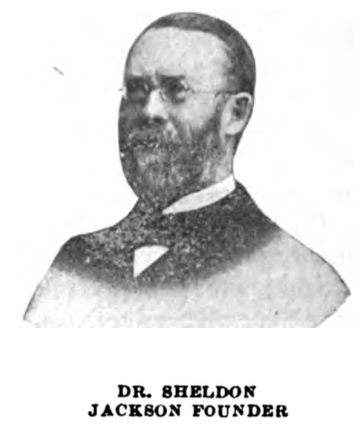
In the future history of Utah this college will have an important part. Its origin is due to that large-hearted pioneer of our Church in the West, Dr. Sheldon Jackson, whose name it fitly bears. In May, 1895, he addressed the following letter to the Presbytery of Utah:


To the Presbytery of Utah:

Dear Brethren: Having in the good providence of God been the first Presbyterian minister to commence missions in Utah, I cannot help being deeply interested in the progress of the work you are so successfully carrying forward in the midst of such great difficulties.

I have sympathetically watched the growth of your school work and your efforts to crown that work with a Christian College. Such an institution seems so essential to the highest success of your efforts that I make you the following propositions:

1st. If the citizens of Salt Lake City will provide not less than fifty acres of land suitable as a site for such a college and in a location acceptable to the trustees of the same; and

2d. If the trustees of the proposed college will legally bind the same in its charter or otherwise (a) To make the Bible a regular text-book in the curriculum of studies. (b) To provide that the college can never be alienated from the work and doctrines of the Presbyterian Church in the United States of America, as set forth in the standards of said church;

(c) To provide that the institution shall be named and always continue to be known as the “Sheldon Jackson College;” (d) To provide that if at any future time these conditions shall be materially changed the property will be forfeited to the “Board of Aid for Colleges and Academies of the Presbyterian Church in the United States of America,”

I will pledge myself and heirs to give towards the endowment of such a college the sum of $50,000, the same to be paid as soon as I can dispose of Washington (D.C.) City real estate to that amount.

I shall promise to raise and pay the salary (not to exceed $1,500 per annum) of the President of the college for a few years until other arrangements can be made, together with necessary traveling expenses for a year or two while he is at work upon an endowment.

Praying that you may have God’s blessing and with wisdom and direction of the Holy Spirit in the founding of the educational institution in the name and for the honor of the Lord Jesus Christ,

I remain your brother in Gospel work,
(Signed) Sheldon Jackson.


The very next day the charter of a college was drawn up, and its incorporation shortly followed. The need of such an institution in Utah and the appropriateness of putting it in Salt Lake City hardly have to be argued.

Utah is soon to become, if not already, one of the greatest of the western states. She comes nearer being self-supporting in a greater variety of products than any other state in the Union. Professor Newberry, who formerly occupied the chair of Geology in Columbia University, and who has made several tours of exploration through this territory, stated that Utah has a larger amount and variety of mineral wealth than any other equal area in the United States. Everything indicates that Utah will soon be filled with a great population. Salt Lake City will soon have a population greater than Denver, Omaha, or Minneapolis have now. With this city as a center, and within a radius of four hundred miles lies about one-third of Colorado, Wyoming, Idaho, and Nevada. Within that circle our Church is not intruding upon ground already occupied by any other Christian College.

There ought to be a Presbyterian College here to secure and make permanent the important results of twenty-five years of extensive educational work by our church. During this time we have spent somewhere about $600,000 for educational work alone. We should have a college to complete the academic system which we have so thoroughly organized throughout the state. We have four academies in Utah, represented by substantial two-story brick buildings, costing on average not less than $12,000 each, and with over five hundred pupils, at Mt. Pleasant, Springville, Logan, and Salt Lake City, the latter the most beautiful and complete school building in Utah. This should in some way be identified with the college, as the preparatory department. In all our schools in Utah, we have not less than twenty-one hundred pupils, and including the states adjoining Utah, the number of our pupils is greatly increased. To have no college in such a centre as this leaves us to the remorseless logic that in our Christian educational work, we either do far too much, or we are not doing enough.

It is of the greatest importance that the friends of Christian education in the Presbyterian Church should establish a college here in order to avert the disaster of having Mormons control the higher education in this important new state. The University of Utah in Salt Lake City, is a Mormon institution, with a Mormon president and faculty, and more than five hundred students. The Agricultural College at Logan has the same Mormon equipment, and over two hundred and fifty students. The Brigham Young College at Logan, with one hundred and fifty students, and the Brigham Young Academy at Provo, with two hundred and fifty students, have the same Mormon outfit.

A Christian College here in Salt Lake City would have as its constituency the state of Utah with its three hundred thousand inhabitants; Idaho, with one hundred thousand inhabitants; Western Texas, Colorado, and New Mexico, with two hundred thousand more.

The General Assembly of 1897 made the following utterance: “The announcement of the opening of Sheldon Jackson College for instruction at Salt Lake City is full of encouragement to every Christian visitor, preacher, teacher in the state. We commend the keeping up of the high-grade work in Salt Lake Institute and the making of the Institute the preparatory department of the college.

Then we shall have on the ground a system of education for all who desire it, standing over against the headquarters of Mormonism. We recommend that in view of the enormous evil which now exists and threatens to invade the peace and purity of our population in Utah, and the surrounding states, that special and earnest efforts be made to arrange for aggressive movements in that section of the country, especially in establishing and maintaining schools. It is therefore for this college, in its needs, in its mission, that we make our earnest appeal to the loyal men and women of the great Presbyterian Church.”


PDF available here

The Evangelist (March 23, 1899, p. 13)

The League for Social Service is publishing a series of Anti-Mormon leaflets which will enlighten the public mind as to the evils of this system of religion. The Rev. Josiah Strong, the President of the League, writes on the Political Aspects of Mormonism; the Rev. R. G. McNiece, D.D. treats of the Present Aspects of Mormonism, while the Articles of Faith of the “Latter Day Saints” with Mormon Explanations are compiled by the Rev. J. D. Mutling and the Rev. D. J. McMillan, D.D. There is also an Historical Sketch of Mormonism, by Dr. D. J. McMillan; Methods of Mormon Missionaries, by the Rev. William R. Campbell, and Ten Reasons Why Christians Cannot Fellowship the Mormon Church, issued by the Presbytery of Utah and endorsed by the Congregational and Baptist Associations of Utah. These can be obtained from the League for Social Service, 105 East Twenty-second street, for 35 cents a hundred or $3.50 a thousand.


PDF available here

The Evangelist (January 19, 1899, p. 21)

A Plural Wife. — More than a year ago a teacher in the Primary department of one of the public schools in Utah was a plural wife. Later, the Superintendent declined to give her a certificate as she was a law breaker; but such a storm was raised that he found it convenient to yield and she is now re-instated as teacher. A number of pupils formerly in the mission school are now under her control. ‘Polygamy is taught and practiced. What a spectacle our glorious country presents to the world! A representative Christian nation, and yet Utah, one of its States putting up three different men for Congress by three different parties: Republican, a Mormon with one wife; Democrat, a Mormon with several wives; Populist, an infidel. For whom should a Christian vote?

“The Mormons are bold and defiant. They flaunt their falseness in the face of the people and say, “What are you going to do about it? Help yourselves if you can.” Let us pray mightily for God’s converting power to come upon this people.”

A Cry from Utah. — Rev. S. E. Wishard, D.D., Synodical missionary in Utah, pleads for help. He says: “Our eight vacant school buildings are the skeleton in the closet of our church here. We have learned that two are much more than twice one—a minister and a teacher are much more than twice as effective as either one of them alone. The teacher is indispensable in gathering the young people. Hence the closing of a school means much more than dismissing the pupils. It means a serious loss and crippling of the work. The Mormon power is asserting itself more vigorously than ever. The polygamists are coming to the front with no dread of public dishonor. These facts emphasize the importance of our mission work. Our hope is in the children. If they are handed over to the public schools in which Mormonism is taught, their bondage to the system will be perpetuated. Just so far as Christian education gets hold of their young lives, they are liberated and brought into sympathy with American institutions. Hence, every child into whose life the principles of religion and morality are poured becomes a factor for the final overthrow of the system. Thus even our smallest mission schools become of great importance. One child set right is invaluable in this contest; a few of them are above price. May this heart of our beloved country, about which the serpent has coiled, find a place, a larger place, in the sympathies of our church.”

The Encroachments of Mormonism. — It has been stated that “alarm concerning the progress of Mormonism is beginning to prevail in Ontario. In its political canvass the usual forecasting of the attitude of the religious interests was made, and the estimate based upon it, that before the year passes away there will be one hundred thousand avowed Mormons in the province, which is thought to be within the mark. It is said that meetings are being held in the small halls and school-houses, and that they are crowded with excited audiences, who are carried away by the eloquence of the Mormon missionaries. The method of operation seems to have been carefully planned, and the efforts have been successful beyond what can be easily credited by the average reader.”

H. E. B.


PDF available here

To a dear friend who is now same-sex marriage and LGBTQ-affirming

Friend,

This is all hard. I am thankful for many good years, but I grieve that you have gone down this path. I am committed to maintaining our friendship, but even that shifts in nature because of the spiritual rift.

As I said earlier, I don’t think LGBTQ / same-sex marriage affirmation is isolated. Marriage and male/female normative sexuality is an integral thread of the fabric of Christianity. To pull that thread out is to quickly unravel the whole cloth.

Its hermeneutic and attitude inevitably bring a package of different positions regarding the verbal inspiration of Scripture, the nature of obedient submission, the creation account and Conquest, the unity of the (c)atholic and historic church, proper shame, “mortification of the flesh,” hell, and atonement. This demonstrably plays out in openly LGBTQ-affirming denominations.

It calls into question the whole arc of the Bible, from protology to eschatology—from the prototype and archetype of Adam and Eve, to the dramatic words of Jesus in Matthew 19 during Holy Week, to the “anti-type” of marriage in Christ (the Groom) and the Church (The Bride). As Robert Gagnon puts it, “To convey the legitimacy of homoerotic unions, a different kind of creation story is needed—the kind of story spun by Aristophanes in Plato’s Symposium where an original male-male, female-female, and male-female are split.”

It celebrates what the Bible dramatically highlights as a sin. To be handed over to same-sex lusts is more than a basis for judgment. It is itself a judgment, according to Paul (Romans 1:23). “Same-sex marriage is good” is a modern variation of “Caesar is Lord,” an expression of a competing loyalty that reflects the spirit of the age—an offering of incense to the cultural gods.

For all these reasons, it is tragically schismatic, unbiblical, and unnatural. I lament that.

I will struggle against it—its claims, its attitudes, its cultural currents, and the spiritual forces behind it—for as long as I live. It grieves me to oppose you in this regard.

Let me be upfront with you: I will pray for you as a prodigal or heretic who should repent and submit your heart, will, and intellect under God’s word. “You shall not hate your brother in your heart, but you shall reason frankly with your neighbor, lest you incur sin because of him.” (Leviticus 19:17)

I still hope to enjoy other affinities that God has given us, and to maintain good rapport and long-term friendship.

With sincerity of heart,

Aaron

New site: UtahChurches.com

New site: UtahChurches.com

On August 3, 2022 I posted to friends about an idea to fix up and revamp UtahChurches.org and redirect it to UtahChurches.com:

I’d like to encourage Christians to use it more in their evangelistic encounters. The big idea is to help Utahns simply know what churches are available to them, and to use the site as a way of being invitational and informational as we continue to share the gospel message.

Inviting people to church doesn’t replace evangelism, but we want to make disciples that thrive in local churches.

A lot of Christians in Utah are only aware of 2-3 churches around them. Knowing what other Christian fellowships exist is a tremendous benefit to our shared sense of Christian identity and mission in Utah. It also helps us “persevere in supplication for all the saints” (Ephesians 6:18).

Mormons are even *less* familiar than Christians with what evangelical churches are available to them.

There also are some small Christian churches that are bad at marketing, and I believe this would be a blessing to them.

My list tries to include what I call “reasonably evangelical” churches, yet excludes some on the basis of things like reckless charismata or egalitarianism or other known comparable issues.

The list does not equate to full endorsement. I can also list some particular points of contact for people to get more specific recommendations.

Two years later and it is launched. It is almost entirely automated from a collaborative Google Spreadsheet using Apps Script.

It is a labor of love from a number of volunteers who have been pouring over church data. It has been a joy getting to know the landscape of churches in Utah.