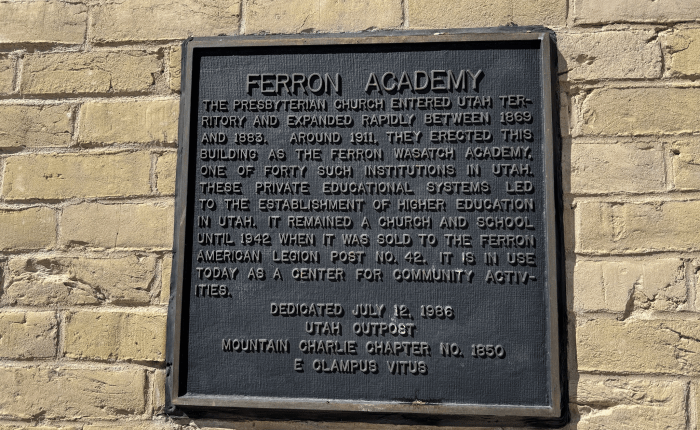
“Presbyterian Missionaries Accomplished Much in Ferron”

“Presbyterian Missionaries Accomplished Much in Ferron”

Source: October 1996 Blazer. Color pictures not in the original.


UTAH’S FRONTIER COMMUNITIES were overwhelmingly Mormon. But in the 1860s Episcopalian congregations were founded in several Utah towns. Especially after 1869, when the transcontinental railroad made western travel easier, other sectarian influences were felt in Utah as well.

One fall a caravan of Christian preachers came through Ferron, Emery County, for instance. The locals called these itinerant ministers “wagon missionaries.” Some Ferronites obviously attended these outdoor meetings, or they would not have been able to recall that a few of the tenets preached there were “radically different” from Mormon beliefs.

Presbyterian missionary efforts tended to focus on education rather than proselyting. Beginning in 1869 Presbyterians built church-school complexes in 33 Utah towns. By 1883, while Presbyterian membership rolls listed only 350 names, 1,789 students were attending Presbyterian grade schools in Utah.

After 1883 the Utah Presbyterian mission did little expanding. One exception was Ferron. In 1905 national Presbyterian leader Sherman Doyle gave a new generation of missionaries this call to arms: “The people are there [in Utah] by the thousands. They are in ignorance, in superstition, and in irreligion…in the spirit of the master let us be willing to spend and be spent in winning the souls of these deluded thousands to his cross and his crown.”

As a consequence, two missionaries, Tom Jones and Mac McKenzie, came to Ferron to try to win over Mormons to a more traditional Christian gospel. They doubled as carpenters, erecting a two-story frame church and schoolhouse. Jones and McKenzie stayed on to become established citizens, serving their church without pay while building many of the substantial frame and brick homes that area settlers were becoming able to afford.

In 1908 the First Presbyterian Church of Ferron bought two lots and began work on a brick complex to consist of a church, school, and manse. The Mormons proved less susceptible to conversion than expected, and funding to complete the buildings did not materialize until 1910. But from that year on the Presbyterian church served as a cultural center in Ferron: home to drama and musical events, a school for grades 1-8, and for a time the town’s only free lending library. Teachers at the school were mostly young women who lived on the second floor of the manse.

Ferron’s local schools were run by the LDS stake and wards. In 1890 the Emery LDS Stake opened a high school in nearby Castle Dale. Ferron Ward had its own high school, but for at least one year its senior class consisted of only two students. One bragged he was the class valedictorian and his sister was its salutatorian.

With no alternative to the Mormon high school, which naturally served as unofficial dating bureau, sometime before 1914 Presbyterians opened a branch of the Mount Pleasant Wasatch Academy in Ferron. Because of its superior, college-trained faculty and the specialized music and art courses available, many Mormon families sent their children to this academy. The tradition continued even into the early twenties, when the state mandated free secular schools in every town and a public high school was built.

In the meantime, the Presbyterian school system made it possible for Protestant children to obtain a complete education without leaving the state. They could attend elementary and middle grades at their own church school in Ferron, high school in either Ferron or Mount Pleasant, and college at Westminster in Salt Lake City. The Wasatch Academy in Mount Pleasant as well as Westminster College thrive to this day.

But by 1942 most of Utah’s Presbyterian schools had served their purpose. They may not have greatly enlarged the church’s membership rolls, but they had been a force in the establishment of free, public education throughout the state and had served as a model for the new secular system. In addition, they had enriched the cultural landscape of 33 communities, helping Ferron in particular to evolve from a 19th-century frontier outpost to a cultured 20th century town.

Sources: Wanda Snow Peterson, Ferron Creek: Its Founders and Builders (Bountiful, Utah: Horizon Publishers, 1989); First Presbyterian Church of Ferron Nomination Form, National Register of Historic Places, Preservation Office, Division of State History.

The Outward and Inward Call

God’s outward call says, “Come, believe, and find rest in Christ!”

God’s inward call brings a subconscious change of heart by the Holy Spirit. God opens the eyes in a person to assuredly receive the word.

This distinction doesn’t solve the mystery, but it further describes it.

God genuinely offers, beckons, beseeches through his word:

“Therefore, we are ambassadors for Christ, God making his appeal through us. We implore you on behalf of Christ, be reconciled to God.”
– 2 Corinthians 5:20

Yet there is also a kind of “drawing” that always results in coming to the Son:

“No one can come to me unless the Father who sent me draws him. And I will raise him up on the last day… This is why I told you that no one can come to me unless it is granted him by the Father.”
– John 6:44,65

Hence we pray, “Lord, open their eyes!” And we preach, “Behold what God has revealed!”

Five-Point Trinitarianism

  1. There is one God.
  2. Each divine person is God.
    The Father is God.
    The Son is God.
    The Spirit is God.
  3. Each divine person is not the other.
    The Father is not the Son.
    The Son is not the Spirit.
    The Spirit is not the Father.
  4. Each divine person is distinguished by eternal relations of origin.
    The Father eternally begets the Son.
    The Son is eternally begotten.
    The Spirit eternally proceeds from the Father and the Son.
  5. How God acts in history corresponds to all the above.

19th-20th Century Christian Songs By Year

This post revisits a sample of Christian songs from the 19th and 20th centuries—some of which filled radio stations, living rooms, sanctuaries, and youth groups.

It is good to occasionally exit our modern atmosphere, transcend our cultural preferences, and breathe the old musical air of prior believers. It is good to appreciate the worship heart-language of previous generations of Christians.

“There is one body and one Spirit—just as you were called to the one hope that belongs to your call— one Lord, one faith, one baptism, one God and Father of all, who is over all and through all and in all.”

Ephesians 4:4-6

Years are approximated to authorship, translation, or initial prominence. Linked renditions are almost always from a later time.

(In progress: adding 19th century songs.)

Continue reading “19th-20th Century Christian Songs By Year”

Sophistry

When minor things are used to mask major things.

When words are technically true, but substantially misleading.

When true information is used to give false impressions – by design or cowardice.

Mormonism and Homoousios

The Chalcedonian Definition describes Jesus as homoousios with mankind with respect to his humanity:

“He is of the same essence (homousios) as the Father according to his deity, and the same one is of the same essence (homousios) with us according to his humanity, like us in all things except sin.”

In some sense Mormonism teaches that the Father and Son are homoousios, and that humanity is homoousios with all the exalted gods.

Thus the chasm between Mormonism and Christianity is more about the ousia of deity itself than whether the Father and Son are homoousios. It posits a potentially infinite number of beings and infinite particles of matter that God did not (and even cannot) create. Hence, Mormonism substantially (even if not superficially) rejects the very first line of the Nicene Creed:

“I believe in one God, the Father almighty, maker of heaven and earth, of all things visible and invisible.”

This is more fundamental than its superficial rejection of homoousios. Regarding that term Ron Huggins says,

“Mormons delight in targeting this word homoousios in the creed as making a serious departure from the Bible into the realm of philosophical speculation. I have never read a Mormon writer who notices that homoousios echoes the earlier use of ousia… Or that the introduction of both words can be seen to represent a fairly modest clarification, namely that Jesus was the Son, not the creature of the Father. An idea, by the way, that Mormons agree with.

“Indeed, I sometimes wonder why Mormons, in the midst of attacking the word, have never paused long enough to notice that their own doctrine might be able to apply homoousios in a much more comprehensive way, by using it to describe how all humans are of the same species as God.

“Mormons regularly say that we’re all of the same species as God. Why not simply take homoousios to refer to that in the context of plurality? Were they to do so, it might actually bring more clarity to Christian-Mormon discussion by setting out in sharper relief the difference between the biblical and the Mormon meaning of the term ‘only-begotten’.” (“Those Abominable Creeds”, by Ron Huggins, 25:44)


Added December 10, 2025

Caveat to watch out for: Christians affirm that the Father and Son are homoousios in a different manner (as God, per divine simplicity) than creatures can be of the same species.

Technology and items I have enjoyed in 2024

Remember, I am a computer programmer.

  • Speechify. With this I audibly consume PDFs, papers, articles, and Kindle books.
  • GitHub Copilot in VS Code. Fancy autocomplete as I code.
  • ChatGPT. I am in a constant conversation with the 4o model, and lately, with o1-mini for architectural questions.
  • Apple Voice Memos transcription. Say I have a 9am meeting. At 8:30am on my commute I will verbalize my thoughts in preparation. Then, when I arrive at the office, I ask ChatGPT to polish and organize the transcribed thoughts in bullet points or slides.
  • SelfControl app for Mac. Does an irreversible block on distracting web sites for a set amount of time. Helpful for getting in the zone.
  • Warp terminal. Supports copy and paste and normal text cursor behavior in the command line.
  • MacWhisper. I use this to quickly transcribe YouTube videos. Instead of watching a laborious recording, I can quickly peruse a transcript and find interesting parts. Better than YouTube’s native transcription.
  • Signal Messenger. Far better than iMessage, Telegram, WhatsApp, etc.
  • Bear Notes. My second brain, with near-instant full-text results. I have years of notes. Infinitely better than the now-notorious Evernote.
  • Google Photos. Among my favorite software of all time. Frequently showing me historical and recent pictures of family and friends.
  • Emporia Vue. Newly acquired. This home energy monitor helps me track energy usage while I work to reduce our electricity bill. In reality, this will probably just motivate me to pay more attention to our Nest programming for AC & furnace.
  • Rode Wireless Mic Go II (lapel). MRM/UCRC has a set for recording lectures, debates, and street interviews. They are wonderful.
  • Oreck bagged vacuum. Proven and reliable, unlike nearly every other modern fancy vacuum which chokes on small socks.
  • Weighted vest + reading glasses. This is a simple way to burn calories while reading and walking.
  • Mr. Pen No Bleed Gel Highlighters. Still a favorite for active reading.
  • District Tri Crew t-shirts. 8 bucks. I can wear them multiple times before washing in some seasons.
  • Keurig coffee machine. Insert pod. Push button. Wake up.
  • Stainless steel chainmail scrubber. 9 bucks. Great for my cast iron breakfast pan.

Eternal Progenitorship, Christianity, and Mormonism

This principle of eternal divine progenitorship in Christianity is found in God having always eternally begotten the Son.

In the late Joseph Smith (cf. Sermon in the Grove) it is in every Son having a Father, and every Father having a Son.

For Joseph Smith, it is found in the infinite regression of generated fathers and sons.

In Christianity, it is in the infinite generation of the eternal Son.

This is why I think that the Book of Mormon’s position on incarnational sonship (the Son became the Son when taking on flash) matters so much. It implicitly rejected eternal sonship and eternal generation, leaving a theological vacuum for eternal progenitorship. It paved the way for Smith to fill in the hole with his future innovation — of infinite regress.

Herman Bavinck on man as the image of God

My favorite quote on the image of God, by Herman Bavinck:

“The whole human person is the image of the whole deity.”

More in context:

“‘Image’ tells us that God is the archetype, humanity the ectype; ‘likeness’ adds the notion that the image corresponds in all parts to the original… This does not refer to certain attributes, either on God’s side or ours, such as the intellect or the soul, but rather that the whole human person is the image of the whole deity…”

“God. The whole being, the whole human person and not just “something” in us is the image of God…”
“It is important to insist that the whole person is the image of the whole God, that is, the triune God. The human soul, all the human faculties, the virtues of knowledge, righteousness, and holiness, and even the human body, all of it images God. Thus, a human being does not bear or have the image of God but is the image of God. As human beings we are the likeness or offspring of God (Gen. 1:26; 9:6; Luke 3:38; Acts 17:28; 1 Cor. 11:7; James 3:9). Therefore, God himself, the entire deity, is the archetype of man…”

“The image thus extends to the whole person; nothing is excluded, soul and body, all faculties and powers, in all conditions and relations. It is of course true that in the same way that God’s attributes are more clearly revealed in some creatures than others, so also the image of God comes out more clearly in one part of the human organism than another, more in the soul than in the body, more in the ethical virtues than in the physical powers. This does not alter the truth that the whole person is the image of the triune God…”

“So the whole human being is image and likeness of God, in soul and body, in all human faculties, powers, and gifts. Nothing in humanity is excluded from God’s image; it stretches as far as and constitutes our humanity and humanness. All that is in God—his spiritual essence, his virtues and perfections, his immanent self-distinctions, his self-communication and self-revelation in creation—finds its admittedly finite and limited analogy and likeness in humanity.”

Source: Reformed Dogmatics: Abridged in One Volume