UTAH’S FRONTIER COMMUNITIES were overwhelmingly Mormon. But in the 1860s Episcopalian congregations were founded in several Utah towns. Especially after 1869, when the transcontinental railroad made western travel easier, other sectarian influences were felt in Utah as well.
One fall a caravan of Christian preachers came through Ferron, Emery County, for instance. The locals called these itinerant ministers “wagon missionaries.” Some Ferronites obviously attended these outdoor meetings, or they would not have been able to recall that a few of the tenets preached there were “radically different” from Mormon beliefs.
Presbyterian missionary efforts tended to focus on education rather than proselyting. Beginning in 1869 Presbyterians built church-school complexes in 33 Utah towns. By 1883, while Presbyterian membership rolls listed only 350 names, 1,789 students were attending Presbyterian grade schools in Utah.
After 1883 the Utah Presbyterian mission did little expanding. One exception was Ferron. In 1905 national Presbyterian leader Sherman Doyle gave a new generation of missionaries this call to arms: “The people are there [in Utah] by the thousands. They are in ignorance, in superstition, and in irreligion…in the spirit of the master let us be willing to spend and be spent in winning the souls of these deluded thousands to his cross and his crown.”
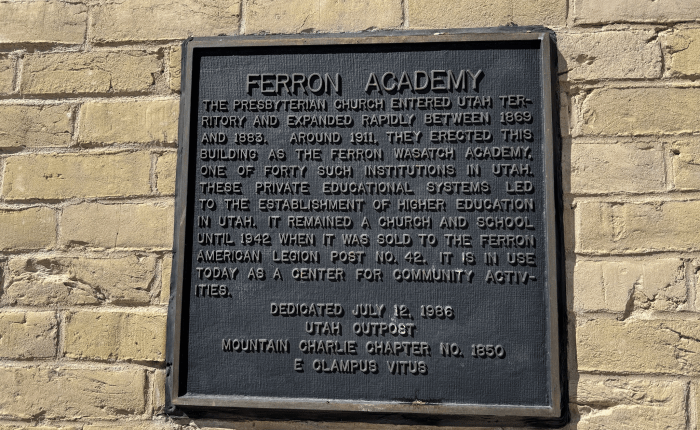
As a consequence, two missionaries, Tom Jones and Mac McKenzie, came to Ferron to try to win over Mormons to a more traditional Christian gospel. They doubled as carpenters, erecting a two-story frame church and schoolhouse. Jones and McKenzie stayed on to become established citizens, serving their church without pay while building many of the substantial frame and brick homes that area settlers were becoming able to afford.
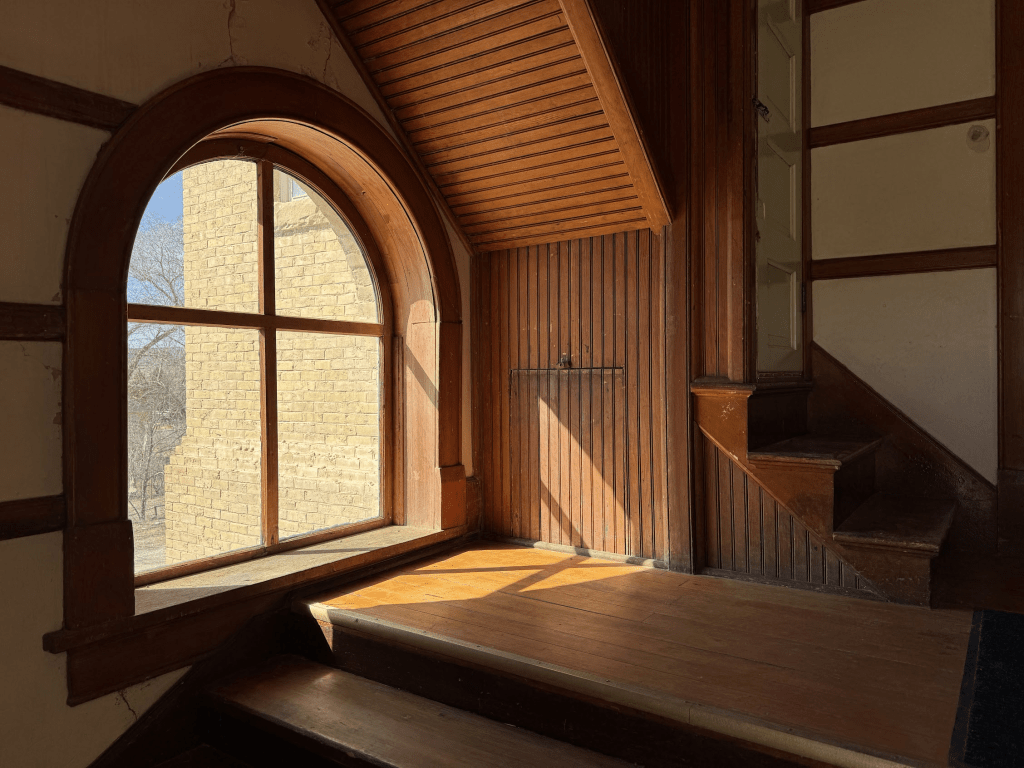
In 1908 the First Presbyterian Church of Ferron bought two lots and began work on a brick complex to consist of a church, school, and manse. The Mormons proved less susceptible to conversion than expected, and funding to complete the buildings did not materialize until 1910. But from that year on the Presbyterian church served as a cultural center in Ferron: home to drama and musical events, a school for grades 1-8, and for a time the town’s only free lending library. Teachers at the school were mostly young women who lived on the second floor of the manse.
Ferron’s local schools were run by the LDS stake and wards. In 1890 the Emery LDS Stake opened a high school in nearby Castle Dale. Ferron Ward had its own high school, but for at least one year its senior class consisted of only two students. One bragged he was the class valedictorian and his sister was its salutatorian.
With no alternative to the Mormon high school, which naturally served as unofficial dating bureau, sometime before 1914 Presbyterians opened a branch of the Mount Pleasant Wasatch Academy in Ferron. Because of its superior, college-trained faculty and the specialized music and art courses available, many Mormon families sent their children to this academy. The tradition continued even into the early twenties, when the state mandated free secular schools in every town and a public high school was built.
In the meantime, the Presbyterian school system made it possible for Protestant children to obtain a complete education without leaving the state. They could attend elementary and middle grades at their own church school in Ferron, high school in either Ferron or Mount Pleasant, and college at Westminster in Salt Lake City. The Wasatch Academy in Mount Pleasant as well as Westminster College thrive to this day.
But by 1942 most of Utah’s Presbyterian schools had served their purpose. They may not have greatly enlarged the church’s membership rolls, but they had been a force in the establishment of free, public education throughout the state and had served as a model for the new secular system. In addition, they had enriched the cultural landscape of 33 communities, helping Ferron in particular to evolve from a 19th-century frontier outpost to a cultured 20th century town.
Sources: Wanda Snow Peterson, Ferron Creek: Its Founders and Builders (Bountiful, Utah: Horizon Publishers, 1989); First Presbyterian Church of Ferron Nomination Form, National Register of Historic Places, Preservation Office, Division of State History.
Source: The Evangelist, December 28, 1899, p. 17. Link.
The rise of the Mormon Church took place in the early part of the century, at the time of the great religious awakening. The young man, Smith, who afterwards claimed the gifts of a prophet, spent his boyhood in idleness. The story of his book of Mormon is familiar history. The work is a tissue of most improbable and contradictory statements, interlarded with quotations from the Bible, sometimes whole chapters. It was undoubtedly the work of Sydney Rigdon, who had been a minister in the Christian Church.
Following the issuance of the book of Mormon, on the title page of which Joseph Smith was announced as “Author and proprietor,” the Mormon Church was organized, April 6, 1830. Though making extravagant claims, its organization was at first very simple.
The whole enterprise was, however, conceived in falsehood and developed in fraud. Many of the early members left the church in disgust, or were cut off from it because of their attempt to correct certain vices which had become a part of the organization.
Yet the strength and development of Mormonism may be readily accounted for. The doctrine of “Continuous Revelation” is the taproot of the whole system. From this source is drawn the authority to make any changes in the system which the exigency may make necessary. Once concede that such a man as Joseph Smith or Brigham Young is “The Prophet, Seer and Revelator;” that he is “the mouth-piece of God;” that he speaks with divine authority; that, as Mr. Roberts says, “he is in reality a part of God,” and the foundation is laid for this stupendous system.
The development of this doctrine of “Continuous Revelation” has subjugated the entire people of the Mormon Church to the will of one man, or at most to the will of that man and his two counselors.
Did Joseph want a luxurious home for himself? He only needed to get a “thus saith Lord,” ordering certain brethren of the church to form a joint stock company and build the house “for my servant Joseph and his posterity forever.” That revelation came in such precise terms as to mention the names of the men thus commanded of the Lord.
Did he wish to clothe himself with divine authority to command the people and “lord it over God’s heritage?” He had no difficulty in getting a revelation instituting the order of the priesthood and clothing it with the power that belongs to God.
When it was discovered in the church that he had fallen into licentious practices, imperilling his character and position, and threatening the disruption of his family and the church, he again had recourse to revelation. True, the book of Mormon, of which he announced himself “the author and proprietor,” three times denounced polygamy and concubinage as abominable and sinful, yet he found no difficulty in getting a revelation from the Mormon God (who is Adam), both approving and authorizing polygamy. Why not? According to further revelation God is a progressive being. He is constantly gaining information. He is learning new things, and what was wrong and “abominable” for David and Solomon he has now discovered to be right for Joseph and Brigham.
In this doctrine of “continuous revelation” lie the germs of all the power of the Mormon Church. This doctrine has furnished designing men authority to construct one of the most thoroughly organized and compacted pieces of ecclesiastical machinery the world has ever seen.
It has adopted a religion suited to every demand of depraved human nature, a religion calculated to sweep into its folds the vicious, the ignorant, the superstitious—every man who wants a religion that will allow him full liberty to live according to his lusts. Mormonism is a mixture of Buddhism, of Mohammedanism, Confucianism, Paganism, Jesuitism, old Judaism. It teaches the doctrine of salvation by merit as thoroughly as Buddhism. The fleshly lusts of Mohammedanism foul the system. It teaches ancestral worship as does Confucianism. The polytheism of the pagans runs through it. The chicanery of Jesuitism has marked its course. It repeats the ceremonies of old Judaism in many things—burdened with rites, ceremonies, and oaths.
The aims of this ecclesiastical immorality are only equaled by its assumptions. This nondescript is masquerading before the world as the only true religion, claiming the right to overthrow all governments, to make constitutions, appoint kings, presidents and all rulers.
Where is its power? In the assumption that it is continually receiving revelations—that God is in and back of its organization, that he is the author of all its dicta. Human responsibility among the masses is at an end. It has been handed over to a priesthood clothed with divine wisdom and power and assumes to be acting for God, as God and “is God.”
The numerical strength of the Mormon Church is not certainly known. It is probably between 250,000 and 300,000. It comprises about three-fourths of the population of Utah, and holds the balance of power in Idaho and Wyoming. It is rapidly colonizing in Arizona, New Mexico and Nevada, and confidently expects to dictate terms to the politicians of that region. The church is counting on determining who shall be the twelve senators from those six states when New Mexico and Arizona come into the Union.
The Christian Churches have a large duty to perform to these deluded people. They should inform themselves therefore concerning conditions in Utah, and courageously meet the exigencies of the hour.
Source: The Evangelist, October 26, 1899, p. 8. Link.
Somewhat over a year ago, an appeal was made by the American Tract Society for special aid in behalf of its colportage work in Utah. In response to that appeal, several Christian Endeavor Societies united in furnishing the funds necessary for the equipment of a Gospel colportage wagon. Other help was generously given, and the result of this united effort is thus expressed in the last annual letter of our valued colporter, Mr. George D. Peacock.
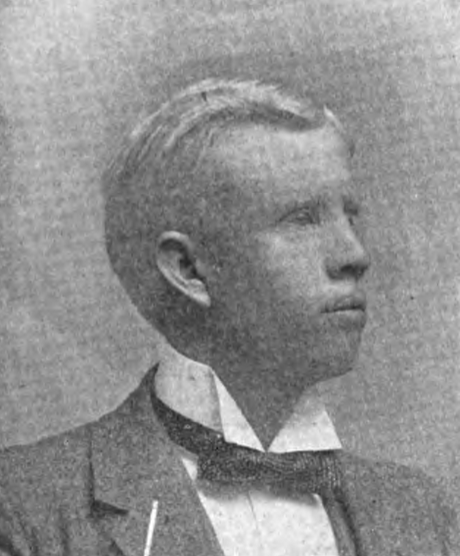
George D. Peacock
“The colportage wagon, which is fitted out with mattress, cooking apparatus, and utensils, tent and such other conveniences as go to make up a first-class traveling equipage, will greatly facilitate carrying on our work. Heretofore much of my work has been along railroad lines, and I have been greatly hampered for lack of facilities for reaching the ‘out-of-the-way places.'”
By means of the colportage wagon, Mr. Peacock has traveled hither and thither, scattering tracts, leaflets, and books, and preaching the word of truth wherever opportunity has offered. Meantime he has been busy with the camera, and the accompanying pictures are but a few of many that have been taken to illustrate his work for the Tract Society.
Gospel Colportage Wagon
As to his methods Mr. Peacock writes:
“Until within the last six months, my work has been along railroad and stage coach lines and places easy of access. The same is true of all missionaries at work in Utah, which means that a large percentage of the people living in remote parts have not Gospel privileges nor have they been supplied with Bibles and Christian literature.
“I opened my first campaign with the new colportage equipage the first of last May, in company with the Rev. Dr. Wishard, the Rev. E. S. Anderson, and the Rev. G. W. Martin.
Our Gospel party set out from Salina, Utah, on a bright May morning, and as we had planned to open our campaign at St. George, Utah, a distance of two hundred and fifty miles, had to be covered. I think words are inadequate to describe the wild, barren and isolated regions through which one travels en route to the ‘Dixie of Utah.’ The St. George road traverses a few productive valleys, then over that great Tushar range whose summit towers up twelve thousand feet above sea level, through the narrows of Clear Creek Cañon, with perpendicular cliffs a thousand feet high on either side, then over a dreary desert waste, and at last over a volcanic range, from whose summit a rapid descent of thirty-three hundred feet in a distance of four miles, brings us to St. George.
“In two days our tent is pitched and seated and everything ready for a series of meetings to last through five weeks. By this time, our plan was discovered by the Mormon officials and we were written up in an editorial in the Deseret News (the church organ). We were soon followed by the First Presidency and some other officials of the Mormon Church, who came down to Southern Utah, to keep their brethren from ‘going astray,’ as they called it. They did not hamper our work, however. Our tent meetings were a success beyond all expectation. Great crowds came night after night, and joined heartily in the singing of Gospel hymns.
“I went on day after day, with my house-to-house visitation, everywhere distributing tracts and bound volumes, praying with the people, and encouraging them to continue in attendance at the meetings.
“I had been through Southern Utah on a colportage tour in the autumn of 1897. St. George was not a strange place to me, and many of the people remembered me, giving assurance that the good books distributed before had influenced them for good.
“Southern Utah, south of the ‘great basin rim,’ has an elevation of twenty-seven hundred feet, and is extremely hot, dry, and sandy; the valleys are narrow and deep; perpendicular walls of red sandstone and black basaltic rock rise up to great heights on every hand. Extinct volcanoes are numerous, and the cragged lava ridges run in every direction.
“The water is highly impregnated with minerals; the supply very inadequate for irrigation. It is amazing how people find a subsistence in such a country. Extreme poverty, ignorance, and immorality are very prevalent. Wine-drinking is indulged in to an appalling degree. Dancing, card-playing, and cigarette-smoking are the favorite ‘pastimes.’
“The first of last July found me in Parowan, Iron County. I left there on the morning of July 4 for Salina, Sevier County. The distance is one hundred and twenty miles, and I was three days on the road.
“One hundred miles of my route lay right along the west bank of the Sevier River. This river traverses several fertile valleys, separated now and then by chains of mountains, through which the Sevier River has cut deep cañons, whose precipitous walls on either side were several hundred feet high.
“There are a great many ranches and several little villages interspersed throughout the whole extent of the Sevier Valley. The people occupying these villages and ranches are nearly all Mormons. They are very illiterate and superstitious, as well as indolent and negligent in all their domestic affairs. They have but little money, and still less of the comforts of life. One does not have to ask these people if they are educated, if they like books, and if they love the flag. Their very houses—houses, for they cannot be called homes—and their surroundings, are sure indications of their condition.
“I visited many of these ranches. Many of the people were entirely without religious reading, and but few of them had even a Bible or a piece of a Bible.
“Such is the country and such is the condition of the people through Southern and Eastern Utah. Blessed work that will carry the Gospel in the ‘printed page,’ into these homes, that it may remain there permanently to accomplish that whereunto it has been sent!”
Since writing the above, Mr. Peacock has been actively engaged in the work of distributing Christian literature through Utah.
From The Messenger, courtesy American Tract Society.
An Appeal to Every True Presbyterian Interested in Higher Christian Education
The Sheldon Jackson College Salt Lake City, Utah
Solicits the aid of the entire Presbyterian Church in the U.S. of America, and proposes a novel plan for raising $250,000 and giving the donors full and valuable return for these subscriptions in home building sites in Salt Lake City.
Like “Bread cast upon the waters,” your charity is likely to return a hundredfold.
We want all true Presbyterians to give us not only their prayers and moral support but their financial assistance to build this College and aid in rooting out Mormonism, which all Presbyterians must feel is a menace to our Church in Utah, besides being a blot on the bright escutcheon of our enlightened civilization.
There is no place in the country where Presbyterian money will accomplish more for Christian education, by counterbalancing false religion, and giving Christian training to those who will eventually be controlling citizens in a half a dozen States, than by PLANTING A CHRISTIAN COLLEGE AT SALT LAKE CITY.
A Presbyterian College has already been planted here with the approbation of the General Assembly. That College, however, is more in name than reality. While it has its Faculty, and its first class almost ready to graduate, it has no college building. In order to make permanent the mission and educational work of our Church in Utah during the past, a complete Christian College outfit is an imperative necessity. The thousands of young men and women we have taken through the preparatory schools and academies of Utah, must either stop their studies at this point or be turned over to Mormon universities and to the immoral influence of the Mormon Church from which we have rescued them.
We Can and Must Rally Our Own People to the Work that God Has Laid Before Us and Prevent This Calamity.
The Proposed Sheldon Jackson Presbyterian College at Salt Lake City Utah
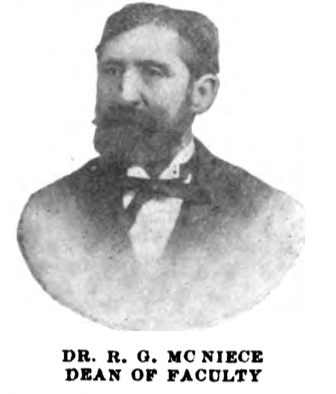
Officers: General John Eaton, LL.D., President Robert G. McNiece, D.D., Dean of Faculty Rev. Josiah McClain, Secretary Gull S. Peyton, Treasurer
Trustees of the College: Rev. S. E. Wishard, D.D., Rev. Geo. W. Martin, Seth H. T. Huse, Gill S. Peyton, Henry G. McMillan, Rev. Wm. M. Paden, D.D., Rev. Sheldon Jackson, D.D., Rev. C. M. Shepherd, V. M. Brown, Edward B. Critchlow, Joseph R. Walker, Rev. N. E. Clemenson, Robert G. McNiece, D.D., Rev. Josiah McClain, Col. Wm. M. Ferry, Walter Murphy (deceased), Albert S. Martin, Rev. Hugh B. McCreery, George Bailey, LL.B.
As is well known, the Mormon Church commences with the Kindergarten school to twist the minds of its little children with its false doctrines. Our missions and preparatory schools gather in many of these children, but for the lack of a Christian College, they are drawn back to the baleful influence of the Mormon universities.
With these facts in view, no Presbyterian in America can refuse us aid in the establishment of this College, knowing that it means the DIRECT SALVATION OF THOUSANDS OF SOULS that would otherwise be perverted to Mormonism.
WE GIVE YOU REAL ESTATE
A valuable piece of property adjoining the College has also been put at the disposal of the College. This has been sub-divided into city building lots. The value of these lots is from $150 to $400 each, according to size, location, etc. Irrigation privileges are included in the deed to the property.
THESE LOTS WILL BE DEEDED FREE OF ALL EXPENSE TO THOSE WHO WISH THEM, WHO DONATE TOWARDS THE BUILDING OF THE COLLEGE THE AMOUNT EQUAL TO THE VALUE OF A LOT.
If you desire to enroll your name among those who will contribute to this noble educational movement, the most practical and efficacious form of Home Missionary Work, SEND YOUR SUBSCRIPTION AT ONCE, and the Board of Trustees will present you with the best lots then remaining, in the order of precedence. As the number of lots is limited, and as there will no doubt be a great demand for them, it is advisable that your contribution reach us as soon as possible.
One of the principal reasons why these lots are presented by the Directors in exchange for subscriptions is the wish of the founders of the College to get as many Presbyterians as possible personally interested in this movement, and it is thought by giving them lots they will have greater personal interest than if they simply donated so much money outright.
All contributions will be immediately acknowledged in this paper.
Subscriptions should be sent by check, New York draft, or express orders to
Rev. THOS. GORDON, D.D. Financial Agent of the Sheldon Jackson College, No. 625 F Street, Washington, D.C.
SHELDON JACKSON COLLEGE.
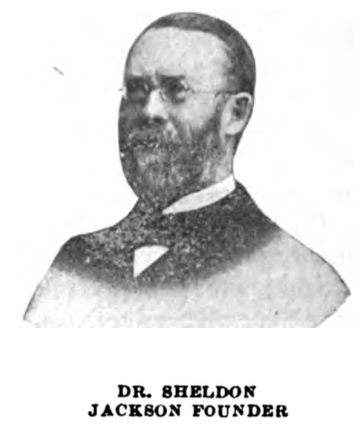
In the future history of Utah this college will have an important part. Its origin is due to that large-hearted pioneer of our Church in the West, Dr. Sheldon Jackson, whose name it fitly bears. In May, 1895, he addressed the following letter to the Presbytery of Utah:
To the Presbytery of Utah:
Dear Brethren: Having in the good providence of God been the first Presbyterian minister to commence missions in Utah, I cannot help being deeply interested in the progress of the work you are so successfully carrying forward in the midst of such great difficulties.
I have sympathetically watched the growth of your school work and your efforts to crown that work with a Christian College. Such an institution seems so essential to the highest success of your efforts that I make you the following propositions:
1st. If the citizens of Salt Lake City will provide not less than fifty acres of land suitable as a site for such a college and in a location acceptable to the trustees of the same; and
2d. If the trustees of the proposed college will legally bind the same in its charter or otherwise (a) To make the Bible a regular text-book in the curriculum of studies. (b) To provide that the college can never be alienated from the work and doctrines of the Presbyterian Church in the United States of America, as set forth in the standards of said church;
(c) To provide that the institution shall be named and always continue to be known as the “Sheldon Jackson College;” (d) To provide that if at any future time these conditions shall be materially changed the property will be forfeited to the “Board of Aid for Colleges and Academies of the Presbyterian Church in the United States of America,”
I will pledge myself and heirs to give towards the endowment of such a college the sum of $50,000, the same to be paid as soon as I can dispose of Washington (D.C.) City real estate to that amount.
I shall promise to raise and pay the salary (not to exceed $1,500 per annum) of the President of the college for a few years until other arrangements can be made, together with necessary traveling expenses for a year or two while he is at work upon an endowment.
Praying that you may have God’s blessing and with wisdom and direction of the Holy Spirit in the founding of the educational institution in the name and for the honor of the Lord Jesus Christ,
I remain your brother in Gospel work, (Signed) Sheldon Jackson.
The very next day the charter of a college was drawn up, and its incorporation shortly followed. The need of such an institution in Utah and the appropriateness of putting it in Salt Lake City hardly have to be argued.
Utah is soon to become, if not already, one of the greatest of the western states. She comes nearer being self-supporting in a greater variety of products than any other state in the Union. Professor Newberry, who formerly occupied the chair of Geology in Columbia University, and who has made several tours of exploration through this territory, stated that Utah has a larger amount and variety of mineral wealth than any other equal area in the United States. Everything indicates that Utah will soon be filled with a great population. Salt Lake City will soon have a population greater than Denver, Omaha, or Minneapolis have now. With this city as a center, and within a radius of four hundred miles lies about one-third of Colorado, Wyoming, Idaho, and Nevada. Within that circle our Church is not intruding upon ground already occupied by any other Christian College.
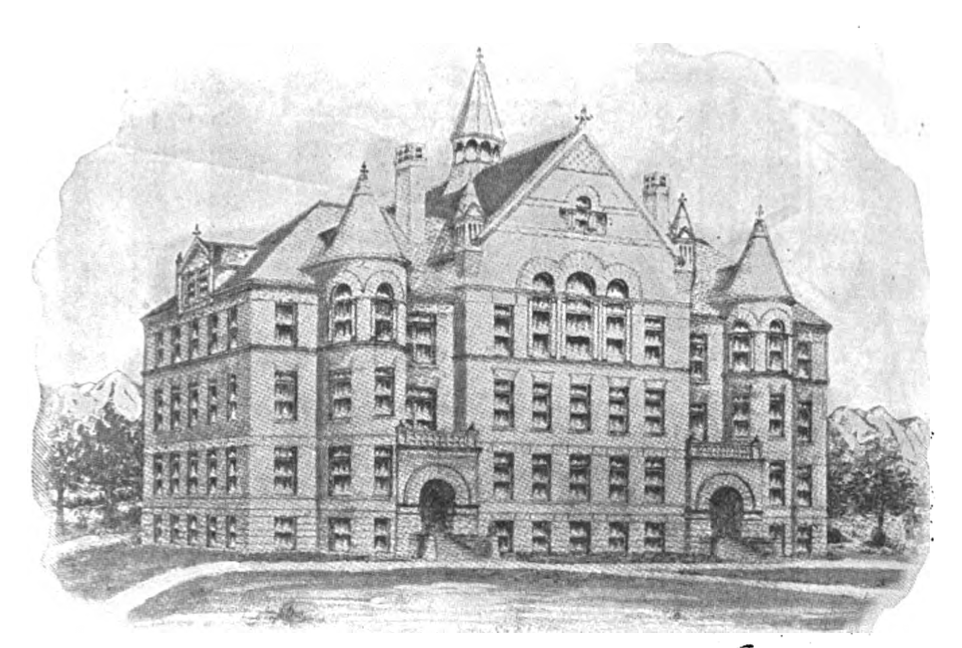
There ought to be a Presbyterian College here to secure and make permanent the important results of twenty-five years of extensive educational work by our church. During this time we have spent somewhere about $600,000 for educational work alone. We should have a college to complete the academic system which we have so thoroughly organized throughout the state. We have four academies in Utah, represented by substantial two-story brick buildings, costing on average not less than $12,000 each, and with over five hundred pupils, at Mt. Pleasant, Springville, Logan, and Salt Lake City, the latter the most beautiful and complete school building in Utah. This should in some way be identified with the college, as the preparatory department. In all our schools in Utah, we have not less than twenty-one hundred pupils, and including the states adjoining Utah, the number of our pupils is greatly increased. To have no college in such a centre as this leaves us to the remorseless logic that in our Christian educational work, we either do far too much, or we are not doing enough.
It is of the greatest importance that the friends of Christian education in the Presbyterian Church should establish a college here in order to avert the disaster of having Mormons control the higher education in this important new state. The University of Utah in Salt Lake City, is a Mormon institution, with a Mormon president and faculty, and more than five hundred students. The Agricultural College at Logan has the same Mormon equipment, and over two hundred and fifty students. The Brigham Young College at Logan, with one hundred and fifty students, and the Brigham Young Academy at Provo, with two hundred and fifty students, have the same Mormon outfit.
A Christian College here in Salt Lake City would have as its constituency the state of Utah with its three hundred thousand inhabitants; Idaho, with one hundred thousand inhabitants; Western Texas, Colorado, and New Mexico, with two hundred thousand more.
The General Assembly of 1897 made the following utterance: “The announcement of the opening of Sheldon Jackson College for instruction at Salt Lake City is full of encouragement to every Christian visitor, preacher, teacher in the state. We commend the keeping up of the high-grade work in Salt Lake Institute and the making of the Institute the preparatory department of the college.
Then we shall have on the ground a system of education for all who desire it, standing over against the headquarters of Mormonism. We recommend that in view of the enormous evil which now exists and threatens to invade the peace and purity of our population in Utah, and the surrounding states, that special and earnest efforts be made to arrange for aggressive movements in that section of the country, especially in establishing and maintaining schools. It is therefore for this college, in its needs, in its mission, that we make our earnest appeal to the loyal men and women of the great Presbyterian Church.”
The League for Social Service is publishing a series of Anti-Mormon leaflets which will enlighten the public mind as to the evils of this system of religion. The Rev. Josiah Strong, the President of the League, writes on the Political Aspects of Mormonism; the Rev. R. G. McNiece, D.D. treats of the Present Aspects of Mormonism, while the Articles of Faith of the “Latter Day Saints” with Mormon Explanations are compiled by the Rev. J. D. Mutling and the Rev. D. J. McMillan, D.D. There is also an Historical Sketch of Mormonism, by Dr. D. J. McMillan; Methods of Mormon Missionaries, by the Rev. William R. Campbell, and Ten Reasons Why Christians Cannot Fellowship the Mormon Church, issued by the Presbytery of Utah and endorsed by the Congregational and Baptist Associations of Utah. These can be obtained from the League for Social Service, 105 East Twenty-second street, for 35 cents a hundred or $3.50 a thousand.
A Plural Wife. — More than a year ago a teacher in the Primary department of one of the public schools in Utah was a plural wife. Later, the Superintendent declined to give her a certificate as she was a law breaker; but such a storm was raised that he found it convenient to yield and she is now re-instated as teacher. A number of pupils formerly in the mission school are now under her control. ‘Polygamy is taught and practiced. What a spectacle our glorious country presents to the world! A representative Christian nation, and yet Utah, one of its States putting up three different men for Congress by three different parties: Republican, a Mormon with one wife; Democrat, a Mormon with several wives; Populist, an infidel. For whom should a Christian vote?
“The Mormons are bold and defiant. They flaunt their falseness in the face of the people and say, “What are you going to do about it? Help yourselves if you can.” Let us pray mightily for God’s converting power to come upon this people.”
A Cry from Utah. — Rev. S. E. Wishard, D.D., Synodical missionary in Utah, pleads for help. He says: “Our eight vacant school buildings are the skeleton in the closet of our church here. We have learned that two are much more than twice one—a minister and a teacher are much more than twice as effective as either one of them alone. The teacher is indispensable in gathering the young people. Hence the closing of a school means much more than dismissing the pupils. It means a serious loss and crippling of the work. The Mormon power is asserting itself more vigorously than ever. The polygamists are coming to the front with no dread of public dishonor. These facts emphasize the importance of our mission work. Our hope is in the children. If they are handed over to the public schools in which Mormonism is taught, their bondage to the system will be perpetuated. Just so far as Christian education gets hold of their young lives, they are liberated and brought into sympathy with American institutions. Hence, every child into whose life the principles of religion and morality are poured becomes a factor for the final overthrow of the system. Thus even our smallest mission schools become of great importance. One child set right is invaluable in this contest; a few of them are above price. May this heart of our beloved country, about which the serpent has coiled, find a place, a larger place, in the sympathies of our church.”
The Encroachments of Mormonism. — It has been stated that “alarm concerning the progress of Mormonism is beginning to prevail in Ontario. In its political canvass the usual forecasting of the attitude of the religious interests was made, and the estimate based upon it, that before the year passes away there will be one hundred thousand avowed Mormons in the province, which is thought to be within the mark. It is said that meetings are being held in the small halls and school-houses, and that they are crowded with excited audiences, who are carried away by the eloquence of the Mormon missionaries. The method of operation seems to have been carefully planned, and the efforts have been successful beyond what can be easily credited by the average reader.”
BAPTIST CHURCH. — Baptist work began in Utah in 1880, by the organization of a Sunday school in Ogden by H. A. Lindley. In 1881 a church was organized there by Dr. Dwight Spencer. Soon after, Dr. Spencer organized the First Baptist Church of Salt Lake City. There are now eight churches with 806 members. The churches are as follows: Bear River Valley; Ogden, O. C. Wright, pastor; Salt Lake City, First, D. A. Brown, pastor; East Side, Frank Barnett, pastor; Calvary, C. O. Boothe, pastor; and there are churches at Murray, Provo and Springville.
—
THE PRESBYTERIAN CHURCH IN UTAH. — Rev. Henry Kendall, D. D., secretary of the board of home missions, in 1864 preached the first sermon in Salt Lake City that was preached by any representative of the Presbyterian Church. Rev. Sheldon Jackson, D. D., Synodical Missionary, landed at Corinne in June, 1869. Regular religious services were commenced on the 13th of June, and on the 14th day of July, 1870, the first Presbyterian church was organized in Utah.
The First Presbyterian Church of Salt Lake City was organized November 12, 1871. Later churches were organized at American Fork, Pleasant Grove, Ogden, Kaysville, Logan, Smithfield, Hyrum, Springville, Spanish Fork, Mt. Pleasant, Ephraim, Manti, Salina, Richfield, Parowan, Nephi, Payson, Benjamin, Central Park in Ogden, Brigham and Collinston. The Westminster and Third Churches in Salt Lake City have been added to the above list. Presbyterians now have twenty-seven churches in Utah.
Educational work, under the care of the Presbyterian Church, was commenced in Salt Lake City by Prof. J. M. Coyner April 12th, 1875. That beginning has developed into the present Salt Lake Collegiate Institute. A few weeks later another school was opened at Mt. Pleasant, and is now the Wasatch Academy. Later another school was opened at Logan, which has now become the New Jersey Academy. The school that was organized at Springville has grown into the Hungerford Academy. The Presbyterian Church has now these four academies, educating about 500 pupils and fitting for college those that wish to pursue advanced studies. This educational work has been recently crowned by the founding in Salt Lake City of the Westminster College, by Rev. Sheldon Jackson, D. D. This institution is now prepared to take the graduates of the four above mentioned academies and give them a college course.
By Rev. John D. Nutting, Secretary Utah Gospel Mission, Cleveland, O.
Even friends who are unusually well posted about Mormonism sometimes ask, “Why is it that we cannot reach the Mormon people more largely with our church and school work?” The following facts among many may help to answer this exceedingly important question, as well as to convey some idea of what Mormonism really is.
First it should be remembered that Christian work among the Mormons has to meet all the difficulties which are found elsewhere. The world, the flesh and the devil in their usual forms are quite as much in evidence there as anywhere else, and quite as hard to meet. But besides these there is a whole set of difficulties peculiar to this particular field, which we must study and overcome before we can ever “solve the Mormon problem.” Some of these are as follows:
1) The natural prejudice of one system against another, intense according to the real or fancied antagonism between either the systems or their adherents, or both. This may be understood somewhat by the prejudice between Catholics and Protestants; though Mormonism is vastly farther from Christianity than Romanism is, and its antagonism will eventually be greater, if it is not so already.
2) The numbers, wealth and organization of Mormonism compared with Christianity in the same regions. In Utah there are about 5,300 members in all the Christian churches together, while the Mormons number about 220,000 in that State; we are not organized so as to work at all closely together, and have small financial ability, while they have practically unlimited resources of both tithing and power over their adherents.
3) The Mormon “Priesthood.” Mormonism is probably the most complete ecclesiastical system ever set in operation, not excepting Jesuitry. Because the priesthood claims to be “a part of God,” and is believed to be such by all good Mormons, it is able to make effective an antagonism to the Christian church and faith which is equal to its own departure therefrom; and this is almost complete. It has one or more resident representatives on every block of a city or village, whose duty it is to visit every family at frequent intervals and if possible to keep them under its control in every department of life; for, as it claims, its “jurisdiction extends over all things spiritual or temporal.” It is easy to see how such a power, with such an inquisitorial knowledge of the affairs of its people, can of itself almost entirely prevent them from even attending our services. Its usual manner of doing this seems to be not so much by direct prohibition, which might provoke rebellion, as by a seeming liberality which is more than neutralized by certain teachings which we must now consider.
4) Systematic, priestly slanders against the Church of Christ and her ministry. Every Mormon is intensely indoctrinated with the following ideas:
(a) That the Christian churches are not really churches at all, but base impositions designed by men for selfish gain; the true church and gospel having been taken back to heaven shortly after the death of the Apostle John, and only restored to the earth through Jos. Smith about 1830. (Some such teaching at this was necessary to make room for the Smith “church” which he wished to found.)
(b) That the Christian ministry is “a spurious priesthood, destitute of divine authority, divine inspiration and divine power * * * set up by ambitious and designing men * * * base counterfeit of the true and heavenly coin”—[which is the Mormon “elder!”]—Mormon Doctrine, p. 21.
(c) That the Christian work done among them by this spurious ministry is for two selfish ends: (1) To build up a sect which shall bye-and-bye overthrow theirs—a motive both selfish and antagonistic, which they will of course not willingly aid. (2) To get “the money there is in it” for the worker (his salary)—another selfish motive. If the pastor claims to be working from spiritual motives, as of course every true pastor is, that makes him a lying hypocrite and so much the worse.
Such teachings are unceasingly dinned into the ears of the people through their “church” paper, their services, in their text-books and in conversation. The following extracts from remarks of “elders” in a service in the Salt Lake Tabernacle, from the Mormon paper of Dec. 18, 1902, will illustrate this point: A Colorado woman having asked the “elder” to give a local pastor some instructions in doing his church work (!) he reports the conversation further as follows:
“I remarked to her that I would willingly do so, but that I was afraid he could not live up to it or teach it to his congregation. ‘Why?’ she asked. My answer was, ‘He requires a salary to preach the gospel. Whenever he arises to preach to his congregation and says that which they do not like, they say that he will have to stop preaching that way or they will stop his salary. Now,’ said I, ‘when I preach to the people I do not care whose toes I tread on; I do not care who I strike; I teach the truth, and no matter where it hits, they cannot come to me and say, “We’ll stop your salary,” because I haven’t any to stop. That’s the difference between your minister and me. . . . I would rather be a humble elder preaching the gospel unto the people, bearing the testimony that Jesus is the Christ and that Joseph Smith is a prophet of God, than to be the greatest “divine” upon the face of the earth.’”
The next speaker in the same meeting said:
“I have a sort of indignant strain in my own blood when I hear these falsehoods spoken against us by men professing to be ministers of Jesus Christ. An appeal was made to the Gentiles who live in our midst, but I do not expect to see any number of them, however long they have lived in our midst, ever stand up and be men enough to deny to the world the lies that are told about us. I do expect, though, that if they go away from Salt Lake City for a period they will enter into the spirit of their brothers and lie with them. That is the only thing I expect from them, especially from those who wear the long coats and are professed ministers of the gospel. We might name many of them to you, but you know them as well as I do. The Latter-day Saints, from the beginning until now, have suffered from the misrepresentation of this class of men, and I expect that we will suffer until Christ comes to reign, from just such men.”
Hundreds of similar statements might be quoted from the same publication during even these later years. Was there ever a more Satanic plan to rob the true gospel message of its power by blackening the characters and motives of its messengers? If so, the writer does not recall it. At any rate it is perfectly clear that we need not expect many Mormons to attend our churches as long as their minds are filled with such devilish falsehoods as these. And when one does attend, the gospel message will usually be able to reach his mind only after it has been blackened and scorched and distorted by passing through several mental strata of these slanders, which were intended to prevent him from attending at all and with which his whole being is permeated. It is simply idle to expect to reach these needy souls within any reasonable time by an agency, unaided, against which they have such an intense and in-trained prejudice.
5) The seclusion of the people. Largely as a result of the causes already noted, the Mormon people are almost entirely secluded from direct Christian influences. About two-thirds of their present number were born into their faith and have grown up in an almost exclusively Mormon atmosphere, while the most of the others have been so long under such influences that earlier teachings have become nearly obliterated. In Utah and Southern Idaho alone there are 145,000 people, mostly Mormons, who have no sort of Christian services in the places where they live; while the almost equal number who live where they might attend will not do so, from reasons already noted. And, besides this, the peculiarities of Mormon belief and practice are such as very generally to render them clannish, and so the more to separate them from better influences.
6) Mormon changes in the meanings of Christian words. Mormonism changes the meaning of almost all the fundamental Christian words and of some others, so that they carry very untrue ideas to its people. The very Word of God is thus robbed of its message and made to speak a false one, and the Christian sermon may become almost a Mormon message before it reaches the thought of its Mormon hearer. To them the word “God” carries the idea of one of many polygamous, flesh-and-bones beings who were once men; “Christ,” that of a son of such a god (Adam) and Mary; “faith,” either a mere head-belief or a semi-miraculous power; “sin,” only an inexpediency; “repentance,” regret at such inexpediency; “baptism,” immersion by a Mormon “elder” to wash away such a sin; “salvation,” bodily resurrection; “atonement,” making such resurrection possible; and so on. The awful results of such perversion of terms can only be imagined by one who has had long experience with it.
7) The difficulty of meeting Mormon error from the pulpit. The fundamental need of the Mormon is not exhortation to do what he already knows. He is not ready for much of that; his ideas are so terribly distorted that it means little to him. His crucial need is to have the awful fallacies of his peculiar beliefs laid before him plainly and kindly, with the corresponding truths of Christianity in contrast. This is a work which requires special gifts, training and experience, which not every pastor can command. And thus far it has been considered very seldom possible for a church to take up such work without incurring a net result of increased hostility against itself, such as has already been outlined.
8) The very sincerity of the Mormon common people in their belief. After visiting in about twelve hundred Mormon homes and talking with them about their beliefs, the writer is convinced beyond a doubt that the common Mormon (he does not speak of the leaders) is very generally sincere in his belief of even the most repulsive features of his system. Most likely having been born into Mormonism, and at any rate having been trained into it by an assiduity which shames most modern teaching of Christianity, why should he not be so—rather how can he help being so? And every atom of this sincerity is an atom of opposition to anything which discredits either the honesty or the contents of his belief. We have hardly given the Mormon people credit enough hitherto at this point, but the fact is fundamental to any proper understanding of the case.
9) The doctrine of “testimony” and continuous revelation. It is hard to deal with a system having a “private wire” to heaven which any one may tap under easy conditions. Such supposed communication renders the people altogether too independent of commonplace matters like the Bible and all the every-day facts and logic and common-sense and history and experience which govern ordinary people—and which govern them in other matters. Many a time have Mormons said to the writer that it made no difference what he said or brought to their notice against Mormon errors, “they had a testimony from God that Mormonism was true and Joseph Smith a prophet sent from God, and nothing whatever could shake it.” Every Mormon is taught from childhood that by a proper course he can and should obtain this special revelation from God; and such is very often his aim. By a psychologic and perhaps partially hypnotic process of excluding contrary facts (if he knows of such), concentrating attention upon falsehoods taught as facts, and subjecting himself to the influence of strong Mormon characters, multitudes of this people reach a genuine conviction of the truth of one of the most damnable frauds ever perpetrated upon suffering humanity; and this constitutes one of the most stubborn difficulties with which we have to deal. It is perhaps at once the climax of priestcraft everywhere and of Satanic delusion. It is the inner fortification of this great system of error. It supplants the Bible by later and more pertinent messages; it makes the Mormon think and say “We have all that you have and much more; why should we come to you for any truth?” in a spirit of conceit and exclusiveness reminding one of the Chinese. And the “private wire,” instead of running to heaven as it is believed to do, is the means by which the arch Enemy himself lures these blinded souls to their own destruction.
We have thus hastily sketched the greater special difficulties which confront any who would rescue the 310,000 Mormons from their crushing delusion and our nation from the menace of this evil. The Church of Christ often finds it hard to make headway against the difficulties of other fields. Can it make the needful progress against the same obstacles here with all these new ones added? If so, it will certainly be one of the greatest proofs of the power of Christianity ever enacted in any age. That it will finally do so, the writer has no doubt. That it will do so with only the localized methods of the past, which were framed for fields having none of these special difficulties, and to overcome which every wile of Satan in these new obstacles has been particularly designed, he has practically no hope, for at least a generation or two. The figures show that in the twelve years from 1890 to 1902 Mormonism has doubled its numbers and more than doubled its power, in spite of all we have done; and we can hardly expect greater effectiveness of these methods in future. They have accomplished much, and must be continued to the full. But if we leave them unaided for another twelve years we shall certainly awake to an educated Mormonism instead of an ignorant one, very probably doubled again in numbers and power, holding absolute political control of the whole region from Canada to Mexico and a strong balance of power in Congress, while the grip of this deadly false religion as a religion upon the souls it now blinds is stronger than ever before; and meanwhile at least 100,000 Mormons will have passed on to eternity without the gospel light which we are commanded to send to them! God has never made a people which could not be reached with His Truth in some way. Reaching even this people is entirely possible. If we fail to do it, in this age of unlimited resources, it seems to the writer that we might as well cease calling ourselves Christians and go on unhindered to the final end of the unfaithful. From mere motives of self-preservation it were the most foolish policy in the world to leave the Utah work without reinforcements at such a critical time as this.
From all the facts thus far brought out, it is evident that the work which shall meet the present need of the Mormon people must be a highly specialized one, fitted for the peculiar situation which confronts it. It cannot be merely a localized effort, because the people will not come to such; nor a denominational or salaried one, for against these they are intensely and continuously prejudiced. It must be more than a match for the priesthood, error, “testimony” and Satan together, or it will fall before these enemies. It must be able to reach the whole people with the gospel leaven rapidly. It must come to them with evident self-denial, on the basis of a common humanity, gladly acknowledging their sincerity and whatever else is good among them as a basis of appeal for all that is better and best.
Such an effort is that of the Utah Gospel Mission, which is incorporated at Cleveland, Ohio. Providentially brought into being, it is believed, out of the highest experience in Utah, its methods thus far have met with unexpected success in coping with the problems presented. Its workers are both unsectarian and unsalaried, living in and working from special gospel wagons the year round, and doing a peculiar and evidently self-denying work along both colporter and evangelistic lines. Devices conceived against “sectarian,” localized, salaried and ministerial work fall powerless before methods which present none of these features. Prejudice is disarmed and even the “priesthood” largely shorn of its power by methods which outwardly resemble its own enough to logically compel a kindly reception of both our men and message. (See I. Cor. 9:15-23.) The people cannot remain away from a work which goes to them, as the early Apostles used to go to the people before there was either church or salary. Even the Mormon “testimony” will fall before facts repeatedly and clearly and kindly brought to bear in self-sacrificing love. The one power stronger than priestly error is that of truth with God behind it; and if this truth be only brought into kindly and wise touch with the needy souls the effect will be simply irresistable. Here is the solution of the Mormon problem, and the salvation of the Mormon people; and the key to it all, under God, is in these methods which can and do reach the whole people with that truth which the Spirit can use mightily.
Cleveland, March, 1908—[3rd Ed.]
Published by the Utah Gospel Mission, Cleveland, O. Price postpaid, single copy 2c.; ten 10c.; 100 75c. Packet of samples of eight leaflets 10c.; including also “Mormon Doctrine” and “Christian Truth,” 20c. Circulate the facts.
The conductors of the American Home Missionary Society have long sought for a favorable opportunity to erect the gospel standard in Utah. Hitherto the difficulties in their way have been insurmountable. The “Gentile” portion of the population has been very small, and the fanatical violence and intolerance of the Mormons have been such that any public and organized efforts to propagate among them religious tenets contrary to their own, would have been hazardous and fruitless. These difficulties are now removed to such a degree that the Executive Committee have resolved to make the experiment. Before calling attention, however, to this undertaking, we desire to state a few of the leading facts in regard to this strange region, and the strange people by whom it is inhabited.
Physical Features of Utah.
Utah was originally a part of the Territory of Upper California, and was ceded to the United States by Mexico in 1848. It is situated west of Colorado, occupying the central part of the great basin of the continent between the Rocky Mountains and the Sierra Nevada, and embracing an area of 109,600 square miles. The largest portion of its surface is either mountain or desert, but between the spurs of the mountains are many beautiful and fertile valleys, sufficient to sustain a large population. The Wasatch range, a lofty spur of the Rocky Mountains, traverses the Territory from northeast to southwest, at the western base of which, on the bank of the Jordan, and twenty-two miles from Great Salt Lake, stands the capital of the territory, Great Salt Lake City.
Utah produces iron, salt, coal, and gold; but the people do not encourage mining. They consider agricultural pursuits more favorable to their “patriarchal institutions.” Stretching southward from the Great Salt Lake is a range of valleys, extending two hundred miles, in which the fruits and grains of the temperate zone are cultivated with success, and other tracts may be reclaimed from barrenness by means of irrigation.
The Mormon Community.
After the massacre of their Patriarch and Prophet at Nauvoo, Ill., in 1844, the Mormons determined to find a home so remote and inaccessible as to preclude the possibility of farther interference in the practice of their abominations. After a temporary sojourn in Western Iowa, Brigham Young, the new Prophet, in the spring of 1847, “marshalled his followers for that long and perilous flight through a wilderness of a thousand miles that lay between the confines of civilization and the home he had chosen for them in the valley of the Great Salt Lake. This terrible journey of an army of men, women, and children, incumbered with household stuff, beset with foes without in the Indians of the plains, weakened by pestilence and fever within, and suffering, sometimes starving, for want of food, was marked, from its beginning to its end, with the graves of the pilgrims. But the indomitable will of their leader, his unbounded influence over his followers, their unswerving belief that they were the chosen people of the Lord, and perhaps the conviction, enforced by years of persecution, that behind them, among their civilized countrymen, they should never find rest for the soles of their feet, sustained them through their long and painful journey, till at length they looked down from the summit of a mountain upon the gleaming beach of the Great Salt Lake, in the valley of which they were to find a resting place.”
Another and larger migration took place in the following year; and in 1849 a State Government was organized, under the name of Deseret. Congress refused to recognize it, but created in its stead a Territorial Government, and Brigham Young was appointed Governor in 1850. The population was, at that time, 11,380. In the following year the Federal courts were broken up by a mob, and the laws of the United States were openly defied. Young was thereupon deposed from office as Governor, but Col. Steptoe, who was appointed to succeed him, did not deem it prudent to assume the duties of the office. In 1856 another outbreak occurred, in which the United States court room was broken open by a mob, and Judge Drummond was obliged to adjourn his court. In the next year another Governor was appointed, and an army of 2,500 men was ordered to attend him for his protection and the enforcement of the laws. The history of this costly and disastrous expedition is doubtless familiar to our readers, and need not be recited. Peace was at length secured, in 1860, through the negotiation of Col. Kane, of Philadelphia, and the army was withdrawn. The population of the Territory, in that year, was 40,273. Since that time the Federal laws have been generally enforced, protection has been enjoyed by all residents, the mineral and other resources of the Territory have been developed, and the Gentile population has rapidly increased.
It has hitherto been deemed impracticable to establish the institutions of evangelical religion in Utah. The people were, with few exceptions, of the Mormon faith, burning with resentment towards their former persecutors, and determined to resist the invasion of all “Gentile” sects. The first attempt, so far as we are informed, to carry the sword of the Spirit into the stronghold of this self-styled Lion of the Lord, has been made by the American Home Missionary Society.
Reconnaissance of the Territory.
During the last summer a reconnaissance of this and the adjacent Territories was made, under the auspices of this Society, by President Blanchard, of Wheaton College, Illinois. The facts gathered by him, and by Samuel Holmes, Esq., of New York, who visited the Territory at about the same time, not only impressed the Committee with the importance of occupying this field, but afforded unexpected encouragement to undertake the enterprise at once. Pres. Blanchard says: “Salt Lake City has 20,000 inhabitants without religious teaching, except the ribald babbling of Mormons. Children are growing up without Sabbath schools, and there are not one hundred decent books in the whole Territory, for which Hon. John D. Kinney, in his late Washington speech, claims a population of 100,000. If the Gospel is preached in the whole Territory, I do not know where; I do know that there are none but Mormon meetings in Great Salt Lake City, which represents the Territory as its metropolis. Brigham Young, the Chief Priest, is building a new theater here, 148 by 88 feet, and 50 feet high—a fact which indicates the moral condition of the multitudes swarming in these desert regions. In the best, and kindest, and most intelligent family I have been in, seven bright children were growing up without the Word of God. A piece of an old Bible is all that this wealthy family possess.”
Gen. P. E. Conner, the commander of the Federal forces in Utah, expressed a deep interest in the establishment of a mission there, and generously proffered in its behalf his personal cooperation, and the protection of the forces under his command. In a communication dated Oct. 25th, 1864, he says:
“The present Gentile population of Salt Lake City numbers, perhaps, from four to five hundred, including many families. This class is increasing very rapidly; and without being too sanguine, I feel justified in saying that, in another twelve months, the permanent Gentile population will number not less than two thousand. Already a large portion of the business community is composed of Gentiles; and the country and trade being opened up here, in the heart of the continent, are attracting hither capital, enterprise, and ability. The development of the silver mines in near proximity to the city is progressing with wonderful energy and rapidity; and there is now, adjoining the mines in Rush Valley, a town of no less than forty comfortable houses already erected. Most of these are tenanted by families who are almost exclusively Gentiles. The great want, however, which has long been sorely felt by the Gentiles in this Territory, has been and still is, an Orthodox christian ministry. Now, they have no place to attend on the Sabbath for public worship, nor are the restraining and humanizing influences of the christian religion thrown around the community. To me it has long been a source of no little surprise that, while the several denominations of the church send their missionaries to the ‘uttermost parts of the earth’ to redeem mankind, it has never been seriously thought that here, between either verge of this great continent, is to be found the grandest field for missionary labor. Leaving out of view, entirely, the wants and religious necessities of the soldiers of this command, and Gentiles congregated here, the Mormon people themselves have greater need of missionary labor than any other people or community on the face of the earth.”
“Without expressing a preference for any sect or division of the church, I would, in common with hundreds, soon to be augmented to thousands, of my fellow-citizens here, hail the coming of a ‘man of God’ to teach Christ and him crucified in this community. So long, at least, as the troops remain here, freedom of opinion and the expression of it, in its broadest American sense, will be protected, and a church could be established here without any apprehension of interference from the Mormon authorities.”
A Mission Commenced.
Thus Providence opened the door before us, and it seemed important to enter it without delay. But whom should we send? The laborers, especially those adapted to such a work, were few. Winter had arrived. The overland route was infested by hostile Indians. In these circumstances it seemed imperative that we should rob one outpost in order to man another still more important. Rev. Norman McLeod, who had been recently stationed at Denver, the capital of Colorado Territory, was instructed, by telegraph, to proceed to Great Salt Lake City, and erect the gospel standard there. He arrived in that city, January 16th, and met an enthusiastic reception. The Daily Union Vedette, a paper published by the officers and soldiers at Camp Douglas, welcomes his arrival in the following terms: “For a long time, perhaps the greatest want seriously felt by residents and sojourners in this vicinity, has been that we have had in all this wide Territory no minister of the Gospel to preach the Word of the living God. Gentlemen deeply interested in the welfare of Utah have long been endeavoring to obtain the services of a preacher and a hall where the people on the Sabbath might listen to something different from Tabernacle harangues. We are gratified to be able to announce that these praiseworthy exertions have at last been crowned with success. The Eastern stage, which reached here on Monday night, brought to our city the Rev. Norman McLeod, who proposes to organize here a congregation for divine worship. Mr. McLeod has been stationed at Denver City, Colorado Territory, where he organized a church which is now prospering. It is not doubted that his zealous efforts in behalf of Christianity will be warmly seconded by the American and loyal citizens of Salt Lake, and that ere long we will boast a thriving church and congregation.”
The Mormons might have thrown a serious obstacle in the way of this enterprise, had not Providence kindly deprived them of the power. They would, of course, have refused the use of any public hall as a place of worship for a christian congregation; but the Young Men’s Literary Association, having previously leased the most eligible hall in the city, kindly opened it for that purpose. The inauguration of this movement is thus noticed by the Vedette: “Sunday, January 22d, 1865, will ever be a memorable day in Utah. If we mistake not, when the anniversaries of battles, of bloody fields and heroic struggles shall have been forgotten, yesterday will be remembered with praise and thanksgiving. It was indeed the dawn of a new era, and an important step towards civilization and the advancement of the people was taken.”
“In the hall of the Young Men’s Literary Association of Great Salt Lake City, a christian congregation was organized by Rev. Norman McLeod. The hall was more than crowded, and many were unable to obtain seats. At 11 o’clock a most impressive sermon was delivered from the text, ‘Can any good come out of Nazareth? Come and see.’ Rarely have we listened to a more argumentative or eloquent discourse. The purity of diction, the soundness of views, the breadth of argument, and the extent of christian charity exhibited, spoke alike for the head and heart of the preacher. It was a novel thing to hear the word of the living God proclaimed in Utah—to hear the preacher lift up his voice in behalf of our country, and teach Christ and him crucified. We were gratified to see that the large congregation was not entirely composed of so-called ‘Gentiles,’ but many of the Saints were present. To them as to others the words of the preacher were adapted. ‘Come and see.'”
We congratulate the friends of Home Missions that God has thus granted us the privilege of setting up the standard of evangelical truth at the center of Mormon corruption and delusion. We would not attempt, however, to forecast the issue of this experiment. It will of course encounter the bitter opposition of these fanatics—the enemies alike of our Government and our religion. But, assuredly, Utah is in the “uttermost parts of the earth” which are given to Christ for his possession. By the preaching of his Gospel, that system of abominations which has so long disgraced our land and age, is to be brought to naught. Let all who pray for the peace of Jerusalem unite their supplications that the seed sown in that stubborn soil may yield an abundant increase till, over all those deserts and mountains, “THE FRUIT THEREOF SHALL SHAKE LIKE LEBANON.”





 I Am Aaron Shafovaloff