
- Am I willing to do the work to “rightly divide” this text?
- Do I have basic reading comprehension? Do I even know the text, or am I hastily making ignorant conclusions?
- Am I depending on God in prayer for the Holy Spirit to open my eyes?
- Am I optimistic about generally knowing the basic meaning?
- Am I content with the incomprehensibility of God and his works? Does this lead me to worship or to frustration?
- Am I posturing myself before the Bible as God’s very inerrant, inspired, binding, infallible word? Am I putting myself under the word or over it?
- Am I willing to bend the intellectual knee, though the text may offend my cultured, sophisticated, modern sensibilities?
- Would the truth of this text rebuke me or cause me inconvenience? Am I motivated to avoid the meaning of this text?
- Am I committed to principled, courageous obedience, no matter whatever it says?
- Do I see this text as merely old, or as having ongoing, living, active power, as the very word of God?
- What does a trusted Christian community have to say about this text? Am I making an abrupt departure from historic Christianity?
- Do I desire to be one in mind with other believers?
Category: Uncategorized
Loving the least of these
The thirsty, hungry, sick, and imprisoned in Matthew 25:31-46 are the “least of these.” This is not generic to humanitarian aid (though that’s elsewhere in Matthew 6:1; cf. Galatians 6:10).
“Least of these” is idiomatic to the disciples of Jesus. Jesus himself says that these are his “brothers” (25:40; cf. 10:42, 18:6, 18:10, 18:14).
Giving a drink of water to the “least of these” means expressing practical affection to fellow believers, especially when they’re in trouble.
We learn elsewhere that the world loves to hate such disciples (John 15:18-25). So loving them comes at a cost: Guilt by association. Loss of social capital and cultural respectability. Someday, perhaps even your livelihood.
So when you see the world heap shame on a faithful believer, enraged, shouting “Great is Artemis of the Ephesians!”, rise up.
Sacrifice your cultural respectability. Despise the praise of man. Embrace the “shame” of being Christian. Give the drink of water to the untouchable brother.
Train your eyes to look for the believers that the world hates, and throw in your lot with them. And hear Jesus say, “Come, you who are blessed by my Father, inherit the kingdom prepared for you from the foundation of the world.” (Matthew 25:34).
But if you find yourself joining the dog pile of disdain on believers, be warned: “Do you not know that friendship with the world is enmity with God? Therefore whoever wishes to be a friend of the world makes himself an enemy of God.” (James 4:4)
The term “least” of these (25: 40, 45) uses the superlative form of the adjective “little one,” which is one of Matthew’s unique ways of referring to Christians (10: 42; 18: 6, 10, 14; cf. 5: 19; 11: 11). Matthew 10:40-42 offers a close parallel with its promise of reward for those who offer even small acts of kindness to itinerant disciples. So it seems most likely that Jesus is referring to deeds of compassion done for suffering, persecuted Christian emissaries. Because one has accepted the message of the gospel, one is concerned to care for its messenger. Moreover, these “sheep” are not, as it is sometimes alleged, surprised that they are accepted as Christ’s followers (the “anonymous Christian” theory); they are surprised only when they are told that they ministered directly to Jesus, since he no longer lives on earth in incarnate form. But Jesus assures them that he is present in every one of his followers to whom they have ministered. None of this absolves us of the responsibility to care for the non-Christian needy of our world; we simply have to turn to other texts for that teaching.
Blomberg, Craig L. (2009-08-01). Jesus and the Gospels (p. 380). B&H Publishing Group. Kindle Edition.
See also:
Reasons to slow down and listen in evangelism
Reasons to slow down and listen:
1. Restraint shows wisdom. “Whoever restrains his words has knowledge, and he who has a cool spirit is a man of understanding.” (Proverbs 17:27)
2. Patient listening is contrary to a quick temper. “Whoever is slow to anger has great understanding, but he who has a hasty temper exalts folly.” (Proverbs 14:29) “My dear brothers and sisters, understand this: Everyone should be quick to listen, slow to speak, and slow to anger.” (James 1:19)
3. Patient listening helps slow the conversation down to reduce unnecessary quarreling or tension. “And the Lord’s servant must not be quarrelsome but kind to everyone, able to teach, patiently enduring evil.” (2 Timothy 2:24)
4. It is shameful to hastily speak. “If one gives an answer before he hears, it is his folly and shame.” (Proverbs 18:13)
5. You’re less likely to act foolishly if you keep your cool. “A man of quick temper acts foolishly, and a man of evil devices is hated.” (Proverbs 14:17)
6. Patience is persuasive. “With patience a ruler may be persuaded, and a soft tongue will break a bone.” (Proverbs 25:15)
7. Restraining your words means you have less to regret. “Whoever keeps his mouth and his tongue keeps himself out of trouble.” (Proverbs 21:23)
8. It’s prudent to let some things slide. “The vexation of a fool is known at once, but the prudent ignores an insult.” (Proverbs 12:16)
9. Listening helps you ponder how to answer. “The heart of the righteous ponders how to answer, but the mouth of the wicked pours out evil things.” (Proverbs 15:28)
10. You can silently pray for someone, even as you are actively listening to them. “Pray without ceasing.” (1 Thessalonians 5:17)
Continue reading “Reasons to slow down and listen in evangelism”The Lord of glory: crucified
Titles That Remind Us One Nature Can Be Used of the Person Even When the Action Is Done By the Other Nature
The New Testament authors sometimes use titles that remind us of either the human nature or the divine nature in order to speak of the person of Christ, even though the action mentioned may be done only by the other nature than the one we might think of from the title. For example, Paul says that if the rulers of this world had understood the wisdom of God, “they would not have crucified the Lord of glory” (1 Cor. 2:8). Now when we see the phrase “the Lord of glory” it reminds us specifically of Jesus’ divine nature. But Paul uses this title (probably intentionally to show the horrible evil of the crucifixion) to say that Jesus was “crucified.” Even though Jesus’ divine nature was not crucified, it was true of Jesus as a person that he was crucified, and Paul affirms that about him even though he uses the title “the Lord of glory.”
Similarly, when Elizabeth calls Mary “the mother of my Lord” (Luke 1:43), the name “my Lord” is a title that reminds us of Christ’s divine nature. Yet Mary of course is not the mother of Jesus’ divine nature, which has always existed. Mary is simply the mother of the human nature of Christ. Nevertheless, Elizabeth can call her “the mother of my Lord” because she is using the title “Lord” to refer to the person of Christ. A similar expression occurs in Luke 2:11: “For to you is born this day in the city of David a Savior, who is Christ the Lord.”
Grudem, Wayne A.. Systematic Theology: An Introduction to Biblical Doctrine (p. 562). Zondervan. Kindle Edition.
On Biblicism vs. Being Biblical
Biblicism is marked by:
- Superficial reading of Scripture without attention to harmonizing the whole canon.
- Reducing a theological argument to proof texts at the expense of inductive arguments.
- Treating as foreground in the text what must be brought from the background through theological reasoning.
- Not being aware of or intentional about theological interpretation (the interplay of a theological hermeneutic with the historico-grammatical method?)
- Limiting oneself to the foreground — express statements and not considering good and necessary consequences.
- Tendency to see as positive law what is instead an expression of natural law.
- Refusal to use extra-biblical terminology to express or safeguard Biblical ideas.
Jack Alton Phillips (1928-2002)


Divine Simplicity Summarized

Steven J. Duby’s summary in Divine Simplicity: A Dogmatic Account, 81-86:
(1) “God is pure act and is therefore not composed of act and potency.”
(2) “God is entirely spiritual and is therefore not composed of corporeal parts.”
(3) “God is his own form (deitas) and is therefore not composed of matter and form.”
(4) “God is his own divinity subsisting and is therefore not composed of nature and suppositum or individual.”
(5) “God is really identical with each of the persons of the Trinity and is not composed by them.”
(6) “God, who is his own essence, is identical with his own existence also.”
(7) “God transcends classification and demarcation and is therefore not composed of genus and species.”
(8) “God is identical with each of his own attributes.”
(9) “God is wholly himself and not susceptive of any composition at all.”
(10) “Finally, while God is fully himself and incomposite in himself, he is also not joined to other things as though he might become part of a composite.”
Matthew Barrett on theories of Biblical inspiration
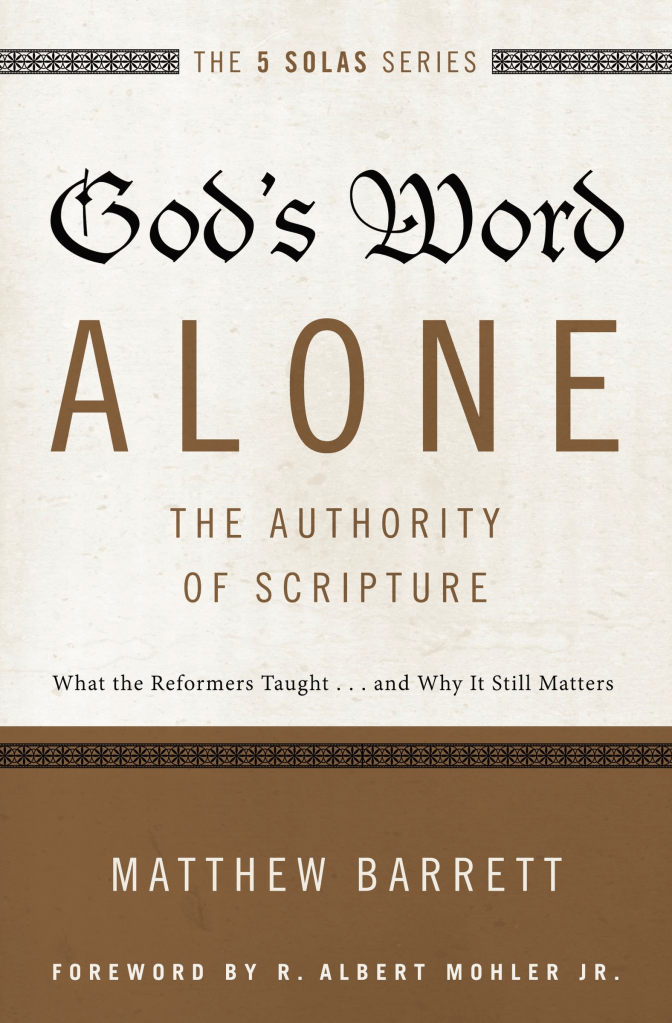
“The intuition theory teaches that the biblical authors possessed a religious instinct, or intuition, one that is also present in other ancient pagan philosophers. This view rejects the universal, absolute truth claims made by the biblical authors.” 
“The illumination theory goes a step further, suggesting that the Holy Spirit was active, having influenced the biblical authors, increasing their insight. However, while the Spirit’s impression may have been different in degree, it was not any different in kind, for he leaves his impression on others too.”
“The encounter theory argues that though the Bible is not that different from other religious books, nevertheless it is unique when the Spirit utilizes it as a means of revelation within the community of God. Though the Bible is not inherently the Word of God in this theory, it becomes the Word of God when applied by the Spirit, which entails that inspiration is an ongoing process.”
“The dynamic theory takes us a step further, arguing that God left a unique, one-of-a-kind impression on the biblical authors. Yet the Spirit’s influence in this view was at the conceptual level; the exact words were left up to the human authors.”
“The verbal plenary inspiration theory, argues that there is a dual authorship to Scripture. In this view the human authors wrote exactly what they intended in their own distinct style, yet at the same time what they wrote was superintended by the Holy Spirit so that what the human author said, God said, down to the exact words and phrases. Since the author’s words are God-breathed, they are without error.” 
“Finally, the dictation theory believes that God literally dictated his words to each human author. Since the mode is strictly mechanical, the human authors were mere secretaries. Unfortunately, some confuse the dictation view with the verbal plenary inspiration view.”
Source: Matthew Barrett, God’s Word Alone. Zondervan Academic (September 20, 2016).
The Father and Son: Incomprehensible
 Arius:
- God’s essence is incomprehensible (cannot be fully grasped) to creatures.
- The Son is merely a creature.
- Therefore the Son does not fully know the Father.
Eunomius (neo-Arian)1:
- God’s essence is unoriginated or ingenerate (not begotten).
- Such a nature is simple (without parts) and comprehensible.
- Therefore the Father doesn’t know anymore about his own essence than we do.
 Gregory of Nazianzus (trinitarian):
- God’s essence is incomprehensible to creatures.
- Both the Father and the Son are God; the Son is eternally begotten of the Father.
- Therefore the Son shares in the same incomprehensibility as the Father.
- And the Father and Son share in the same knowledge of each other.
Glory!
1. “God does not know anything more about his own essence than we do, nor is that essence better known to him and less to us; rather, whatever we ourselves know about it is exactly what he knows, and, conversely, that which he knows is what you will find without change in us.” (Eunomius Fragment II from Socrates “Scholasticus”)
Renihan on human liberty

It is a “dependent liberty.” “The liberty of second causes is not an absolute liberty, but a dependent, relative, or subordinate liberty. The liberty of second causes does not consist in an indifference to, or capacity to act or not act independently of, God’s decree. Rather, the creature’s liberty depends on God’s decree.”
It is a “correspondent liberty.” “The liberty of second causes corresponds to, or fits with, their being and nature. God has made creatures in such a way that they are able to act in a manner corresponding to the measure of their being… We live and act within the limits of the way in which God created us. God has made us able to think, evaluate, and decide. To do so, we use our intellect, or faculty of understanding. So, we cannot act beyond the reach of our capacities or faculties, whether physical or intellectual.”
It is a “concurrent liberty.” “Men act freely in accordance with the scope of their volition, and that God sovereignly accomplishes his purposes through all that they do. The first cause concurs with second causes… Men make plans, but God fulfills his own will through their actions. This is not a “zero-sum game” between the Creator and creatures. Man acts freely, and God sovereignly brings his will to pass. This is the concurrence, or concursus, of the first cause with second causes.”
– Samuel D. Renihan, Deity and Decree
 I Am Aaron Shafovaloff