How To Properly Enjoy a Thanksgiving Feast

The best way to enjoy your feast today:

#1. Receive it with thanksgiving.

Paul writes, “Everything created by God is good, and nothing is to be rejected if it is received with thanksgiving, for it is made holy by the word of God and prayer.” (1 Timothy 4:4-5)

This covers both permission and proper enjoyment.

If you asked the apostle, “WHAT am I permitted to eat and drink?” The answer would be: whatever you can—in good conscience—receive with thanksgiving.

If you asked the apostle, “HOW am I to eat?” The answer would be: with a prayer of thanksgiving.

Feasting with the spirit of thanksgiving in a win-win. It multiplies the pleasure of eating. G.K. Chesterton puts it this way: “Gratitude is happiness doubled by wonder.”

Continue reading “How To Properly Enjoy a Thanksgiving Feast”

Benefits of a closed members-only chat group

  • It gives more visibility to membership additions and removals, which in turn helps us feel the already-meaningful nature of church membership.
  • It’s an especially safe place to be in conversation with each other: we are in covenant with each other and committed and accountable to each other as members of the local body.
  • Such chat groups have become an important center of socializing for the body.
  • Such groups are where conflict or hard conversations occasionally happens, some of which we’d rather keep internal.
  • Having a more private group frees us up a bit to talk about internal issues more.
  • It can motivate us to encourage those long-standing non-member attendees to finally join as members. Or if necessary, to find a church where they feel like they can join in good conscience.
  • All this doesn’t stop us from having more open-invite chat groups.

Utah Evangelist Conference (2022)

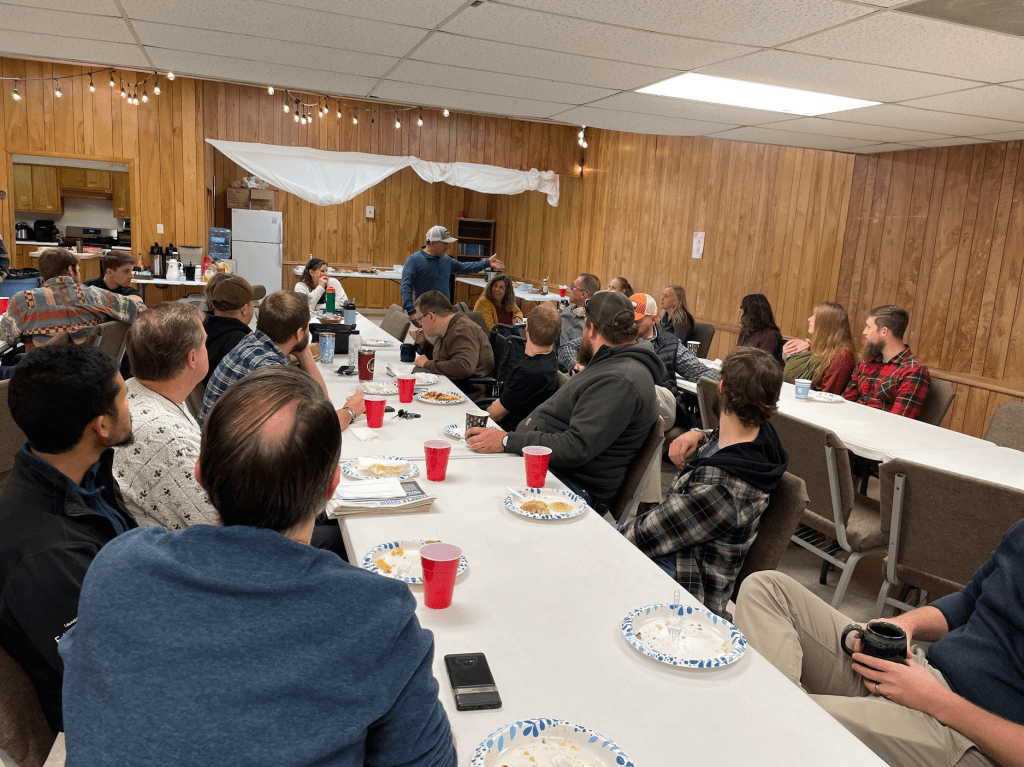
On Saturday, November 19 we gathered at First Baptist Church of Provo, Utah, for the Utah Evangelist Conference. This was a close-of-season fellowship event for the evangelists who have been laboring throughout Utah.

We ate and sang and celebrated another year of God lavishing us with gospel proclamation opportunities and evangelistic fellowship.

Key part of the event: introductions and reports.

We each introduced ourselves with names, churches, and descriptions of evangelism.

It was good to meet each other, know what evangelistic opportunities are available, and be encouraged by the work that God is doing through other believers.

The Gravity of The Fall

Mastricht on why the Fall is MUCH than we realize:

IV. Finally, this violation of the covenant of nature is great, nor can it be lamented enough: it is the principal offense of the whole human race, and the greatest calamity of the world.

In it we should observe not this nor that specific sin, whether of gluttony, or pride, or theft, as the papists prefer, but rather, the seedbed and sewer of all sin.

For in it was pride, ingratitude, unbelief, idolatry, disobedience, carelessness, perverse curiosity for knowledge, concupiscence of he worst kind, theft of a forbidden thing, heartlessness, murder against the whole world, treachery and violation of the covenant; indeed, in the violation of this sacrament so sacred was a declaration of universal disobedience, contempt of the covenant, rebellion, and total apostasy from God.

All of which are aggravated immeasurably from the circumstances, for example:

(1) from the person, loaded with so many benefits from God, furnished with so many talents, and not liable to any stimuli to sin, through original righteousness and the divine image.

(2) From the object, that he overflowed with such a great abundance of things that he could have abstained from just one tree without any trouble.

(3) From the place and time, that hardly formed by his Creator, and placed in the garden and sanctuary of God, at one or two assaults of the tempter, he immediately threw down his arms, instead of defending his own and his posterity’s salvation.

Each of these could be amplified in such a way that it would be evident to the eyes of all that this sin was simply the greatest.

Petrus van Mastricht in “Theoretical-Practical Theology, Volume 3: The Works of God and the Fall of Man”

The Fall was the Great Apostasy.

Christological heresies as superheroes

Apollinarianism: Avatar
The divine mind dwells in a human body but without a human mind.

Nestorianism: Venom
A union of two persons.

Eutychianism: Spiderman
Two natures fused into one nature.


Suggested by Thomas G.:

Ebionism: Batman
Might be mistaken for a superhero but really just a regular dude.

Docetism: Superman
Appears to be human but isn’t.


Suggested by Luke W.:

Adoptionism: Sam Wilson as Captain America – Appointed the title, equipment, and role but is not Captain America by nature and is not equal in power or status to Steve Rogers, the true Captain America who appointed him.

Modalism: Nightwing – The second of three superhero roles taken on by the single person Dick Grayson (Robin, Nightwing, and Batman) at various stages and situations in Gotham’s redemptive history.

An analogy for Calvinism, Arminianism, and Semi-Pelagianism

Leighton Flowers inadvertently gives a great analogy describing the difference between Calvinism, Arminianism, and semi-Pelagianism:

“Pretend for this analogy that a person is in a room with eyes. He has the ability to see. And he has a light on.

“That’s Adam in the garden… He’s right there with the light. The Father [and him are] having good communion. He has the ability to see and he has the light right there with him.

“Well, he sins, and so he’s cast out of the garden where the light is. And so that person is now in a room without any light… Now he’s unable to commune with the Father because he’s out of the Father’s fellowship. And even though he holds a hand up in front of his eyes, he can’t see it because he’s in complete darkness.

“So that is a form of inability. It’s an inability because of a lack of light. And so what he needs outside the garden is… light. He needs incarnation. He needs revelation. He needs scripture. He needs light… That’s all that we think he needs.

“The Arminian—or the classical Arminian maybe, and maybe the full Calvinist—would say, not only when he [was] cast out of the garden did he lose light, he also lost sight…. His eyes were plucked out and the light bulb was taken away.

“So there’s two conditions that need to be met now. There needs to be light brought to this person. And he needs to be given new eyes.

“The Arminian says he’s given new eyes through prevenient grace to the point where he now can make a free choice with regard to what he sees.

“The Calvinist says he’s given new eyes to which whenever he sees the light he effectually will believe it.

“The Provisionist¹ says he never lost his eyes. He just needed light. So that would be the distinction between our worldviews.” (December 22, 2020, YouTube 1:15:42)

¹ Many would simply call this semi-Pelagianism. This position isn’t new.

More on Leighton Flowers here.


What an incredible analogy for salvation. Remember it next time you sing:

Amazing grace how sweet the sound
That saved a wretch like me I once was lost,
but now I’m found
Was BLIND but now I see!

The Heterodoxy of Leighton Flowers

Updated December 10, 2022

Leighton Flowers sharply departs in significant ways from the Protestant tradition. He teaches that:

1. The Fall weakened, but did not fundamentally wreck—not even in principle—man’s ability to orient his heart to faith. Our moral ability to choose to believe was unaffected by the Fall.

Continue reading “The Heterodoxy of Leighton Flowers”

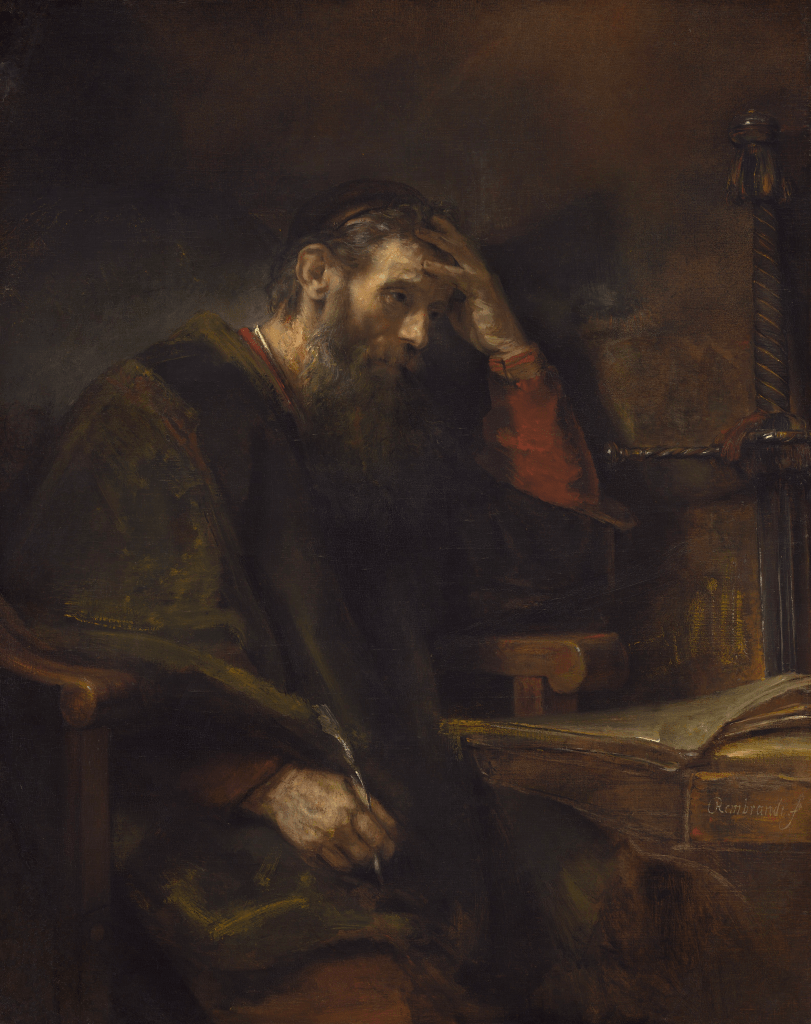
Why was Paul accepted an apostle?

Paul was accepted by Christians because:

  • He did not preach a different gospel (Galatians 1:6-9).
  • He went from violently opposing Christians to preaching that he had seen the risen Christ (Galatians 1:23-24).
  • God moved in others to pay attention to him and receive his words as the very words of God (Acts 16:14, 1 Thessalonians 2:13).
  • The other apostles did not oppose him, but concurred with him (Galatians 2:7-9).
  • He was accompanied by signs and wonders. “The signs of a true apostle were performed among you with utmost patience, with signs and wonders and mighty works.” (2 Corinthians 12:12)
  • Believers evaluated what he said according to existing scripture. “Now these Jews were more noble than those in Thessalonica; they received the word with all eagerness, examining the Scriptures daily to see if these things were so.” (Acts 17:11)
  • He bore the marks of persecution, which he called the marks of Christ (Galatians 6:17; 2 Corinthians 4:7-12).

On grace, faith, and works

T., thanks for your continued patience! Another partial answer for you this morning.

Regarding works, you asked,

“Doesn’t that mean that works are kind of necessary because without them you will have a dead or powerless faith?”

Maybe it would help to separate this question out:

  • Are works necessary as a precondition to salvation? No.
  • Are works necessary to merit salvation? No.
  • Are works necessary to maintain living faith? No.

But we could answer in the affirmative if we frame it differently:

  • Will works necessarily result from living faith? Yes.
  • Are works necessary to glorify God? Yes.
  • Are works necessary to fulfill the purpose God has for our lives? Yes.
  • Are works necessary to demonstrate the authentic Christian life? Yes.

I love your point that it’s important “not to downplay the importance of works.” There are a few texts that bring grace and works together in a beautiful way.

The first is Luke 7:36-49, where Jesus tells the parable of two men who are forgiven of their debts. The one who is forgiven more, loves the one who forgave him more. Jesus draws out a principle: “He who is forgiven little, loves little.” Forgiveness melts the heart of a sinner. It comes freely. It attaches us to the one who loves us. “We love because he first loved us.” (1 John 4:19)

The second text is Colossians 3:13: “As the Lord has forgiven you, so you also must forgive.” The irony of this passage is that I am unable to obey it if I am not first forgiven! So I must receive this forgiveness freely and then forgive others from that state of being forgiven. If I insist on achieving forgiveness by works, then I can’t obey this command. Being freely forgiven by faith only, and receiving the Spirit by faith only, is what empowers me to love my enemies, and forbear with difficult people, and pray for my enemies, and live by the Spirit.

So works don’t maintain our faith. Rather, our living faith energizes our works. This is why Paul speaks of “faith working through love” (Galatians 5:6).

I must maintain a distinction between faith and works (Romans 4:5), and between works and grace (Romans 11:6), yet it is grace and faith that set the stage for the best and only and most powerful way to become a loving and forgiving person who keeps God’s commandments. Faith is a very “weak instrument” — it has a simple, needy, dependent, empty-handed posture of receiving from another. It trusts in the righteousness of another. When faith grows strong, it only grows more confident in its neediness and dependence on another. It says, “I am not righteous; Christ alone is righteous.” It declares spiritual bankruptcy. It looks to the worthiness of another. Then it is given instant and free access to the riches of Christ’s righteousness.

Ironically, this is the only way to become a person that does works that please the Father. This is the only way to have works at final judgment (Matthew 25:31-46) which show the evidence of my identity in Christ and the real transformation that the Spirit did in me. I must trust in Christ only, by faith only, and then, and only then, can I bear fruit.

Jesus said, “As the branch cannot bear fruit by itself, unless it abides in the vine, neither can you, unless you abide in me.” (John 15:4). I must be connected to the vine to bear fruit. Therefore, bearing fruit is not what connects me to the vine.

In summary:

  • Our works are evidential, but not meritorious.
  • Work are inevitable, but not identical to our faith.
  • We are prepared for works (Ephesians 2:10), but they are not a prerequisite to our salvation (Ephesians 2:8-9).

I hope this encourages you. This free grace also helps inform the way we pray to God for mercy. “Lord, help! Forgive me. I believe, help my unbelief. Forgive me, an unworthy sinner. Don’t change me, and then later forgive me. No, Lord, forgive me now freely, and then transform me!”

Grace and peace in Christ,

Aaron