How long will you lie there, you sluggard? When will you get up from your sleep? Proverbs 6:9
Lazy hands make a man poor, but diligent hands bring wealth. Proverbs 10:4
He who gathers crops in summer is a wise son, but he who sleeps during harvest is a disgraceful son. Proverbs 10:5
Diligent hands will rule, but laziness ends in slave labor. Proverbs 12:24
The lazy man does not roast his game, but the diligent man prizes his possessions. Proverbs 12:27
Laziness brings on deep sleep, and the shiftless man goes hungry. Proverbs 19:15
A little sleep, a little slumber, a little folding of the hands to rest–and poverty will come on you like a bandit and scarcity like an armed man. Proverbs 24:33-34
‘What are we to make of Christ?’ There is no question of what we can make of Him, it is entirely a question of what He intends to make of us. You must accept or reject the story.The things He says are very different from what any other teacher has said. Others say, ‘This is the truth about the Universe. This is the way you ought to go,’ but He says, ‘I am the Truth, and the Way, and the Life.’ He says, ‘No man can reach absolute reality, except through Me. Try to retain your own life and you will be inevitably ruined.’
CAN’T YOU LEAD A GOOD LIFE without believing in Christianity? This
is the question on which I have been asked to write, and straight away,
before I begin trying to answer it, I have a comment to make. The question
sounds as if it were asked by a person who said to himself, ‘I don’t
care whether Christianity is in fact true or not. I’m not interested
in finding out whether the real universe is more like what the Christians
say than what the Materialists say. All I’m interested in is leading
a good life. I’m going to choose beliefs not because I think them true
but because I find them helpful.’ Now frankly, I find it hard to sympathise
with this state of mind. One of the things that distinguishes man from
the other animals is that he wants to know things, wants to find out
what reality is like, simply for the sake of knowing. When that desire
is completely quenched in anyone, I think he has become something less
than human. As a matter of fact, I don’t believe any of you have really
lost that desire. More probably, foolish preachers, by always telling
you how much Christianity will help you and how good it is for society,
have actually led you to forget that Christianity
is not a patent medicine. Christianity claims to give an account
of facts–to tell you what the real universe is like. Its account of
the universe may be true, or it may not, and once the question is reality
before you, then your natural inquisitiveness must make you want to
know the answer. If Christianity is untrue, then no honest man will
want to believe it, however helpful it might be: if it is true, every
honest man will want to believe it, even if it gives him no help at
all.
As soon as we have realised this, we realise something else. If Christianity
should happen to be true, then it is quite impossible that those who
know this truth and those who don’t should be equally well equipped
for leading a good life. Knowledge of the facts must make a difference
to one’s actions. Suppose you found a man on the point of starvation
and wanted to do the right thing. If you had no knowledge of medical
science, you would probably give him a large solid meal; and as a result
your man would die. That is what comes of working in the dark. In the
same wavy Christian and a non-Christian may both wish to do good to
their fellow men. The one believes that men are going to live forever,
that they were created by God and so built that they can find their
true and lasting happiness only by being united to God, that they have
gone badly off the rails, and that obedient faith in Christ is the only
way back. The other believes that men are an accidental result of the
blind workings of matter, that they started as mere animals and have
more or less steadily improved, that they are going to live for about
seventy years, that their happiness is fully attainable by good social
services and political organisations, and that everything else (e.g.,
vivisection, birth-control, the judicial system, education) is to he
judged to be ‘good’ or ‘bad’ simply in so far as it helps or hinders
that kind of ‘happiness’.
Now there are quite a lot of things which these two men could agree
in doing for their fellow citizens. Both would approve of efficient
sewers and hospitals and a healthy diet. But sooner or later the difference
of their beliefs would produce differences in their practical proposals.
Both, for example, might be very keen about education: but the kinds
of education they wanted people to have would obviously be very different.
Again, where the Materialist would simply ask about a proposed action
‘Will it increase the happiness of the majority?’, the Christian might
have to say, ‘Even if it does increase the happiness of the majority,
we can’t do it. It is unjust.’ And all the time, one great difference
would run through their whole policy. To the Materialist things like
nations, classes, civilizations must be more important than individuals,
because the individuals live only seventy odd years each and the group
may last for centuries. But to the Christian, individuals are more important,
for they live eternally; and races, civilizations and the like, are
in comparison the creatures of a day.
The Christian and the Materialist hold different beliefs about the
universe. They can’t both be right. The one who is wrong will act in
a way which simply doesn’t fit the real universe. Consequently, with
the best will in the world, he will be helping his fellow creatures
to their destruction.
With the best will in the world … then it won’t be his fault. Surely
God (if there is a God) will not punish a man for honest mistakes? But
was that all you were thinking about? Are we ready to run the risk of
working in the dark all our lives and doing infinite harm, provided
only someone will assure us that our own skins will be safe, that no
one will punish us or blame us? I will not believe that the reader is
quite on that level. But even if he were, there is something to be said
to him.
The question before each of us is not ‘Can someone lead a good life
without Christianity?’ The question is, ‘Can I?’ We all know there have
been good men who were not Christians; men like Socrates and Confucius
who had never heard of it, or men like J. S. Mill who quite honestly
couldn’t believe it. Supposing Christianity to be true, these men were
in a state of honest ignorance or honest error. If their intentions;
were as good as I suppose them to have been (for of course I can’t read
their secret hearts) I hope and believe that the skill and mercy of
God will remedy the evils which their ignorance, left to itself, would
naturally produce both for them and for those whom they influenced.
But the man who asks me, ‘Can’t I lead a good life without believing
in Christianity?’ is clearly not in the same position. If he hadn’t
heard of Christianity he would not be asking this question. If, having
heard of it, and having seriously considered it, he had decided that
it was untrue, then once more he would not be asking the question. The
man who asks this question has heard of Christianity and is by no means
certain that it may not be true. I le is really asking, ‘Need I bother
about it? Mayn’t I just evade the issue, just let sleeping dogs lie,
and get on with being “good”? Aren’t good intentions enough
to keep me safe and blameless without knocking at that dreadful door
and making sure whether there is, or isn’t someone inside?’
To such a man it might be enough to reply that he is really asking
to be allowed to get on with being ‘good’ before he has done his best
to discover what good means. But that is not the whole story. We need
not inquire whether God will punish him fur his cowardice and laziness;
they will punish themselves. The man is shirking. He is deliberately
trying not to know whether Christianity is true or false, because he
foresees endless trouble if it should turn out to be true. He is like
the man who deliberately ‘forgets’ to look at the notice board because,
if he did, he might find his name down for some unpleasant duty. He
is like the man who won’t look at his bank account because he’s afraid
of what he might find there. He is like the man who won’t go to the
doctor when he first feels a mysterious pain, because he is afraid of
what the doctor may tell him.
The man who remains an unbeliever for such reasons is not in a state
of honest j error. He is in a state of dishonest error, and that dishonesty
will spread through all his thoughts and actions: a certain shiftiness,
a vague worry in the background, a blunting of his whole mental edge,
will result. He has lost his intellectual virginity. Honest rejection
of Christ, however mistaken, will be forgiven and healed–’Whosoever
shall speak a word against the Son of man, it shall be forgiven him.
But to evade the Son of Man, to look the other way, to pretend you haven’t
noticed, to become suddenly absorbed in something on the other side
of the street, to leave the receiver off the telephone because it might
be He who was ringing up, to leave unopened certain letters in a strange
handwriting because they might be from Him–this is a different matter.
You may not be certain yet whether you ought to b ea Christian; but
you do know you ought to be a Man, not an ostrich, hiding its head in
the sand.
But still–for intellectual honour has sunk very low in our age–I hear
someone whimpering on with his question, ‘Will it help me? Will it make
me happy? Do you really think I’d be better if I became a Christian?’
Well, if you must have it, my answer is ‘Yes.’ But I don’t like giving
an answer at all at this stage. Here is a door, behind which, according
to some people, the secret of the universe is waiting for ma. Either
that’s true, or it isn’t. And if it isn’t, then what the door really
conceals is simply the greatest fraud, the most colossal ‘sell’ on record. Isn’t it obviously the job of every man
(that is a man and not a rabbit) to try to find
out which, and then to devote his full energies either to serving this
tremendous secret or to exposing and destroying this gigantic humbug?
Faced with such an issue, can you really remain wholly absorbed in your
own blessed ‘moral development’?
All right, Christianity will do you good–a great deal more good than
you ever wanted or expected. And the first bit of good it will do you
is to hammer into your head (you won’t enjoy that!) the fact that what
you have hitherto called ‘good’–all that about ‘leading a decent life’
and ‘being kind’–isn’t quite the magnificent and all-important affair
you supposed. It will teach you that in fact you can’t be ‘good’ (not
for twenty-four hours) on your own moral efforts. And then it will teach
volt that even if you were, you still wouldn’t have achieved the purpose
for which you were created. Mere morality
is not the end of life. You were made for something quite different
from that. J. S. Mill and Confucius (Socrates was much nearer the reality)
simply didn’t know what life is about. The people who keep on asking
if they can’t lead a decent life without Christ, don’t know what life
is about; if they did they would know that ‘a decent life’ is mere machinery
compared with the thing we men are really made for. Morality is indispensable:
but the Divine Life, which gives itself to us and which calls us to
be gods, intends for us something in which morality will be swallowed
up. We are to be re-made. All the rabbit in us is to disappear–the worried,
conscientious, ethical rabbit as well as the cowardly and sensual rabbit.
We shall bleed and squeal as the handfuls of fur come out; and then,
surprisingly, we shall find underneath it all a thing we have never
yet imagined: a real Man, an ageless god, a son of God, strong, radiant,
wise, beautiful, and drenched in joy.
‘When that which is perfect is come, then that which is in part shall
be done away.’ The idea of reaching ‘a good life’ without Christ is
based on a double error. Firstly, we cannot do it; and secondly, in
setting up ‘a good life’ as our final goal, we have missed the very
point of our existence. Morality is a mountain which we cannot climb
by our own efforts; and if we could we should only perish in the ice
and unbreathable air of the summit, lacking those wings with which the
rest of the journey has to be accomplished. For it is from there that
the real ascent begins. The ropes and axes are ‘done away’ and the rest
is a matter of flying.
Stacia and I began dating six months ago. I spent more time with her in the past half-year than anyone else. We have shared a lot of good memories, partaken of much chips and salsa, laughed, cried, and attended many Campus Crusade meetings, all of which only turned a page in our life. I love you Stacia.
If I could share how we met. On a beautiful day in October, Campus Crusade members met at Young’s Dairy for ice cream as an introductory social event. Running late with laundry, Stacie almost didn’t come, but, only having recently arrived from Florida, her mother made her promise to come to meet people. Oh, remind me to thank her.
She approached the picnic table I was at and asked if she could sit down. I incredulously said, “nooo”, but she smiled wryly and sat down anyway. Yeah, she was cute. After telling her I was a sophmore she decided that I was too young. But as we all know things don’t work out the merry little way we plan them, especially with love, do they? :)
Stacie:
“I love you, Aaron. You’re the cutest! :)”
“For those of you who will read this comment, you might find this humorous. Aaron came over tonight and gave me the incredibly cute dog hugging the vase with the beautiful rose in it. He’s so cute. And we decided to go get chips and salsa since, you know, it’s a thing we do and we’re celebrating 6 months. We get to Chili’s, sit down, ask for chips and salsa, and moments later it arrives. At first glance I noticed…it was NOT the same salsa. Aaron couldn’t even tell the difference…AND thought it was better. (That was probably the toughest moment in our relationship yet. shake of head) I couldn’t believe it. I was so disappointed. I really wanted to cry. For those of you who understand my obsession with Chili’s chips and salsa you know I’m serious. So, instead we settled for a Molten Chocolate Cake…I encourage all of those who haven’t tried it to rush to Chili’s as soon as possible and fight to the last bite as Aaron and I do. Our night ended wonderfully with a beautiful night walk around campus, just enjoying each other’s company and celebrating our love for one another!”
Riverside friends enjoy rollin’ up, then down; up, then down
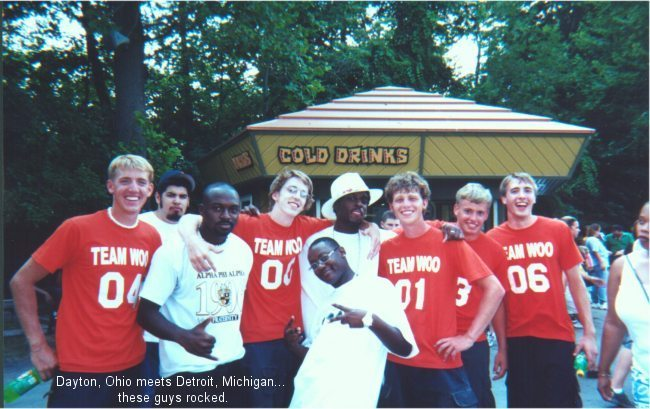
RIVERSIDE – `May the Woo be with you.’
What is Woo? Even more important, who are Woo?
Woo is the sound a group of Riverside roller coaster enthusiasts make when they’re lurching up and down on steel or wooden hills – or waiting in line to lurch up and down on steel or wooden hills.
The group of five calls themselves Team Woo.
Core team members include Riverside residents Brian Charek, 19, a second-year digital design student at the University of Cincinnati; Andy Smith, 17, a junior at Chaminade-Julienne High School; David Kasten, 19, a second-year mechanical engineering student at the University of Dayton; Phillip Shafovaloff, 18, a senior and student body president at Stebbins High School, and his brother, Aaron Shafovaloff, 19, a second-year computer science student at Wright State University.
Aaron designed the team’s Web site – www.teamwoo.com – where others can join Team Woo or post comments about the team’s latest planned trips or sightings, even purchase T-shirts emblazoned with sayings such as `Will Woo for Food.’
Member profiles are included on the site, including one `at- large’ core member, BJ Jeffries, 16, who now lives in Atlanta.
Woo began at Kings Island last summer,’ Charek said.We would just woo at random; we’re not afraid to make fools of ourselves. Then we decided we needed to get organized, and we were really shocked at the response from the crowds.’
According to the Web site, the woo, a loud testosterone-filled sound that is a cross between barking and baying, is the `primary tool that we use to excite a crowd waiting in line.’
Team Woo will go to any length to get a crowd excited. They’ll clap, they’ll woo, they’ll even dance in line.
And usually, by the end of the day, Team Woo is recognized wherever they go.
Team Woo frequently gets stopped by crowds who want to take their picture, and Team Woo has photographically documented their coaster adventures in excruciating detail.
The team has been interviewed by a Michigan radio station, which was broadcasting from Cedar Point during the team’s last visit.
`Fifteen minutes outside of Cedar Point, we’re getting gas and people are driving by wooing,’Charek said.
Woo doesn’t come from the diaphragm,’ Charek said.It comes from the heart.’
`It really gets the adrenaline pumping,’ Smith said.
What really gets the adrenaline pumping is the ultimate Woo ride – Cedar Point’s Millennium Force roller coaster, preferably ridden at night, `although we will ride it during the day,’ Smith said.
`Cedar Point is the coaster Mecca of the world,’ according to Kasten, although all agree King’s Island has great coasters as well.
`The first hill is the best hill,’ Smith said.
A trip to Cedar Point has its own particular traditions, Smith said, starting with a stop at the Wapakaneta Waffle House or at the Frisch’s breakfast bar. Dinner is always at Skyline Chili.
Last week, the team was planning a road trip to Virginia to visit Paramount’s Kings Dominion in Richmond, home to three wooden roller coasters – the Grizzly, the Hurler and the Rebel Yell – and three steel coasters – Flight of Fear, Shockwave and Avalanche.
From King’s Dominion, the team planned on venturing south down the highway to Busch Gardens Williamsburg to ride the steel coasters – Loch Ness Monster, Big Bad Wolf, Alpengeist and Apollo’s Chariot.
Brian’s mother, Monica Charek, thinks Team Woo is great.
`You hear a lot of bad things about teen-agers, but these are all hardworking kids,’ she said.
That’s true. Charek and Kasten work as members of the Dayton Dragons grounds crew, and Phillip Shafovaloff, a lifeguard when the Woo doesn’t beckon, has enlisted in the Air National Guard, where he plans to become an airplane mechanic. He also hopes to get his pilot’s license one day and become the team pilot.
But even Charek’s internship, scheduled for next summer, shouldn’t disrupt the team.





 I Am Aaron Shafovaloff