Theology isn’t a game

“The fear of the LORD is the beginning of wisdom,
and the knowledge of the Holy One is insight.”
– Proverbs 9:10

“If a wise man has an argument with a fool,
the fool only rages and laughs, and there is no quiet.”
– Proverbs 29:9

Francis Schaeffer: “This is not a game I am playing.”

“I need to remind myself constantly that this is not a game I am playing.

“If I begin to enjoy it as a kind of intellectual exercise, then I am cruel and can expect no real spiritual results.

“As I push the man off his false balance, he must be able to feel that I care for him. Otherwise I will only end up destroying him, and the cruelty and ugliness of it all will destroy me as well.

“Merely to be abstract and cold is to show that I do not really believe this person to be created in God’s image and therefore one of my kind.”

—Francis Schaeffer, The God Who Is There (1968), in Francis A. Schaeffer Trilogy (Westchester, IL: Crossway, 1990), 138.

Gregory of Nazianzus: “It is a serious undertaking.”

“Discussion of theology is not for everyone, I tell you, not for everyone—it is no such inexpensive or effortless pursuit. Nor, I would add, is it for every occasion, or every audience; neither are all its aspects open to inquiry. It must be reserved for certain occasions, for certain audiences, and certain limits must be observed.”

Not for the impure

“It is not for all people, but only for those who have been tested and have found a sound footing in study, and, more importantly, have undergone, or at the very least are undergoing purification of body and soul. For one who is not pure to lay hold of pure things is dangerous, just as it is for weak eyes to look at the sun’s brightness.”

Not for every occasion

“What is the right time? Whenever we are free from the mire and noise without, and our commanding faculty is not confused by illusory, wandering images, leading us, as it were, to mix fine script with ugly scrawling, or sweet-smelling scent with slime. We need actually “to be still” in order to know God, and when we receive the opportunity, ‘to judge uprightly’ in theology.”

Not for the unserious

“Who should listen to discussions of theology? Those for whom it is a serious undertaking, not just another subject like any other for entertaining small-talk, after the races, the theater, songs, food, and sex: for there are people who count chatter on theology and clever deployment of arguments as one of their amusements.”

Not with excess

“What aspects of theology should be investigated, and to what limit? Only aspects within our grasp, and only to the limit of the experience and capacity of our audience. Just as excess of sound or food injures the hearing or general health, or, if you prefer, as loads that are too heavy injure those who carry them, or as excessive rain harms the soil, we too must guard against the danger that the toughness, so to speak, of our discourses may so oppress and overtax our hearers as actually to impair the powers they had before.”

On God and Christ, The Five Theological Orations and Two Letters to Cledonius: St. Gregory of Nazianzus

The question of congregationalism

The watershed question which put me down the path of congregationalism:

“Who holds the keys of the kingdom? The elders alone, or the gathered congregation?”

Elder-led (not elder-ruled) congregationalism in a nutshell holds that the gathered members of a local church (autonomous, i.e. not governed by outsiders) express required consensus for:

  1. Members in
  2. Members out
  3. Officers in¹
  4. Officers out

Consensus is also typically typically for changes to major church documents or church decisions, such as a general budget or building purchase.

A fully congregational church will vote on the removal of a member even after the member formally expresses resignation of membership.

An elder-ruled (not elder-led) church will shift most of the above to the sole decision of the elders, and reduce voting of the congregation to a mere affirmation of an existing decision (not mere recommendation) by elders.

An excellent book on the topic is Don’t Fire Your Church Members: The Case for Congregationalism, by Jonathan Leeman.

Baptists are congregationalists in principle, even if somewhat inconsistent in practice.

“Bible churches” (by that name) tend to be elder-ruled, sometimes requiring congregational approval only for the addition of elders.

“The differences between polities tend to emerge when churches are unhealthy and not humble. A healthy and humble elder-rule church may look similar to a healthy and humble elder-led church because those elders are involving the congregation as they should. But you can feel the differences as soon as those churches move toward unhealthy.” (Andy Naselli)

1. Elders and deacons are officers.


Twelve Arguments for Congregationalism, by Jonathan Leeman

Don’t Fire Your Church Members: The Case for Congregationalism, p. 122

Here are twelve biblical reasons why I believe the keys of the kingdom belong jointly to the entire congregation, plus one extrabiblical background argument:

  1. The final court of appeal in a matter of discipline, which is the highest authority in a church, is the church (Matt 18:17).
  2. Jesus says that the church has the authority to make this assessment and judgment because it possesses the keys (Matt 18:18).
  3. Jesus promises that his authoritative presence abides with two or three witnesses to his reign and to one another gathered in his name (Matt 18:20). This locates authority in a gathering. But to say that this promise applies to a gathering smaller than a church would divide a local church against itself and make the basic unit of kingdom authority something smaller than a church, or create churches inside of churches.
  4. There is no mention of bishops or elders in Matthew 16, 18, or 28, nor does the New Testament give a single example of elders or overseers unilaterally exercising the keys.
  5. The apostles treat the gathered congregation as something of an equal partner when selecting and affirming the seven proto-deacons.
  6. Paul invokes the language of gathering with the authority of Jesus to act in Jesus’ name from Matthew 18:20 when he charges not only the leaders of the Corinthian church but the whole congregation to “hand this man over to Satan” (1 Cor 5:4–5). The judgment, to be clear, does not occur behind closed session doors.
  7. Paul explicitly tells the whole congregation that it is their responsibility to judge (1 Cor 5:12).
  8. Paul tells the Galatian churches that they should act as a check even on his apostolic authority when he departs from the gospel (Gal 1:6–9). They don’t need to go outside the system to resolve the problem.
  9. Paul affirms that the decision of the “majority” was sufficient for removing a man from membership (2 Cor 2:6).
  10. Churches can exist without elders (e.g., Acts 14:23; Titus 1:5).
  11. Much of the New Testament is written to whole churches.
  12. This explanation has the advantage of corresponding more closely with the Greek conception of an ekklesia, which involved an assembly of citizens who shared rule together and each had one vote, not an assembly of subjects.

The blinding sun which illuminates

The blinding sun which illuminates

One of those “aha!” connections you can’t unsee, summarized in five ways:

1. God’s secrets are the wellspring of his self-revelation.

2. God’s incomprehensibility is the foundation of our knowledge.

3. God’s exclusive knowledge of himself is the ground of our sharing in the knowledge of who he is.

4. The “unapproachable light” in which God dwells, “whom no one has ever seen or can see” (1 Timothy 6:16), is the very source of our illumination.

5. That God cannot be known except by revealing himself is the basis of our confidence and assurance.

A helpful analogy from Matthew Barrett:

“Like the sun you cannot look at God without going blind. And yet, we cannot see anything apart from the sun illuminating our way.”

More from Anselm:

“Truly, Lord, this is the inaccessible light in which You dwell. For truly there is nothing else which can penetrate through it so that it might discover You there. Truly I do not see this light since it is too much for me; and yet whatever I see I see through it, just as an eye that is weak sees what it sees by the light of the sun which it cannot look at in the sun itself. . . . O supreme and inaccessible light.” (Proslogion)

Moses:

“The secret things belong to the Lord our God, but the things that are revealed belong to us and to our children forever, that we may do all the words of this law.” (Deuteronomy 29:29)

Jesus:

“No one knows the Son except the Father, and no one knows the Father except the Son and anyone to whom the Son chooses to reveal him.” (Matthew 11:27)

Scott Swain:

“The knowledge, love, and beatitude of the blessed Trinity is unapproachably high and holy (1 Tim 6:16), hidden not because it is dark or arcane but because it is supremely luminous, supremely lovely—surpassing what human eyes can see or human hearts can imagine.”

Or as David simply puts it:

“In your light do we see light.” (Psalm 36:9)


See also:

  • “If you can comprehend it, it isn’t God.” (Augustine)

Providence guarantees exposure

“The sins of some people are conspicuous, going before them to judgment, but the sins of others appear later. So also good works are conspicuous, and even those that are not cannot remain hidden.”
– 1 Timothy 5:24-25

“Nothing is hidden that will not be made manifest, nor is anything secret that will not be known and come to light.”
– Luke 8:17, cf. Matthew 10:26

So we might as well::

  • Live “leaky” lives, exposing ourselves, confessing our sins, dropping all pretensions. “I did not cover my iniquity.” (Psalm 32:5)
  • Count the exposure of our sins as a blessing.
  • Seek to have our sin covered by God himself. “Blessed is the one whose transgression is forgiven, whose sin is covered.” (Psalm 32:1)
  • Stare injustice in the face and say, “Your day is coming.”
  • Pray for our enemies, as “the wrath of God is coming.” (Colossians 3:6)
  • Be clear with our agenda. “By the open statement of the truth.” (2 Corinthians 4:1)
  • Practice integrity. “Each one’s work will become manifest, for the Day will disclose it.” (1 Corinthians 3:13)

On Relational Generosity

There is blessing in non-strategic, non-calculating relationships:

– Spending time with people who are not “useful” to you, or of social advantage to you, or who tick the right affinity boxes.

– Building rapport with all sorts of people, not knowing where relationships might go, simply trusting that God will forth good relational fruit.

– Not cutting people off when you find out they are moving away, leaving your local community, or have a serious disagreement. But rather, working all the harder to maintain good rapport.

“A harvest of righteousness is sown in peace by those who make peace.” (James 3:18)

And not just righteousness, but joy, unexpected social connections, and sweet friendships.

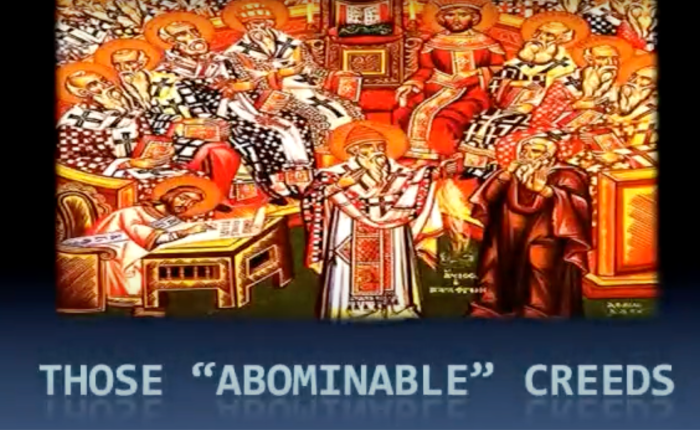
Proto, Mere, And Nicene Trinitarianism

Proto-trinitarianism: There is one God. Jesus is God. “My Lord and my God!” (John 20:28)

Mere trinitarianism: The Father is God. The Son is God. The Spirit is God. The Father is not the Son. The Son is not the Spirit. The Spirit is not the Father.

Nicene trinitarianism: The Son was eternally begotten of the Father, and is of the same substance.

Further expressed: The Son was eternally the Word, the image of the invisible God, the Eternal Son, eternally begotten, in the bosom of the Father, the Wisdom and Power of God, the radiance of the glory of God — and all this independent of creation and before his incarnation.

With the Filioque clause: The Holy Spirit proceeds from the Father and the Son, and with them is worshipped and glorified.

Wayward (social) trinitarianism: There are three wills in God, and each is a distinct center of consciousness. The Son was not eternally begotten of the Father.

How to enjoy the old music of now-wayward Christian musicians:

– Remember how much God used this music to bless you.

– Take every lyric and thought captive to honor Christ (2 Corinthians 10:5).

– Thank God for the music. It’s ultimately from him, not the musician. “Every good gift and every perfect gift is from above.” (James 1:17)

– Pray for the musician to return to their first love.

– Rest in the fact that Christ and his people have final spiritual ownership of all edifying music.

Refusal to greet as the canary in the coal mine

Refusal to greet as the canary in the coal mine

“Leave your gift there before the altar and go. First be reconciled to your brother, and then come and offer your gift.”
– Matthew 5:24

“The friends greet you. Greet the friends, each by name.”
– 3 John 1:15

An unwillingness to greet a fellow believer is relational canary in the coal mine. It shows there needs to be reconciliation.

We greet on the way, as it were, to the communion table. To partake in the same bread and wine together.

If we’re unwilling to greet or be greeted, we should “leave our gift at the altar” and go make things right, at least with due diligence (Romans 12:18).

This is part of “discerning the body” (1 Corinthians 11:29).

See also