Five Benefits of Having Multiple Pastor-Elders in a Local Church

1. “Having multiple elders spreads out the pastoral workload… If you are overwhelmed, don’t just keep gutting it out—shoot up a distress flare and call in brothers for help.”

2. “Plurality enables a church to access the diverse gifting among the elders so that each one operates out of his strengths… See the other elders as part of the divinely engineered tool set for serving your congregation.”

3. “Elders, in plurality, act as pastors to one another… Who shepherds the shepherds? Elders need pastoral care just like everyone else… If you’re going to pastor a congregation effectively, you need to be under spiritual oversight yourself.”

4. “Plurality helps to guard against our domineering tendencies… When elders are practicing a healthy plurality, it’s harder for one man’s views or tendencies to dominate, because the elders offset one another… Plurality creates a structure for elders to call one another out when one of them gets off track.”

5. “It is much more satisfying, and even fun, to pastor as a team than to be a lone-wolf shepherd… One of my greatest ministry joys has been serving with the lay elders of my congregation… These man have been a band of brothers for me and for one another.” A mono-pastorate “robs your pastor of vital support and deep satisfaction. It also deprives other church members of richer pastoral care.”

Source: Church Elders: How to Shepherd God’s People Like Jesus, by Jeramie Rinne.

On Agentic Coding

On Agentic Coding

Tips

  • Use git worktrees
  • Use ast-grep
  • Turn on isolatedDeclarations in TSConfig
    • “With isolated declarations, each file’s type information is self-contained and doesn’t require analyzing its dependencies. This means AI tools can understand a file’s types instantly without traversing the entire dependency graph, leading to much faster code analysis and suggestions.” (🤖)
  • Use Gemini CLI to construct plans
    • “Claude Code pro tip: Ask it to use Gemini CLI with its 1M context window and free plan in non-interactive mode to research your codebase, find bugs, and build a plan for Claude to action.” (X)
    • “Chat priming”
  • Use the Playwright browser automation MCP (X)
    • claude mcp add playwright npx '@playwright/mcp@latest'
    • Or use Browser MCP
  • Describe goals along with tasks.
    • “Many times I find I get the best results by describing my goals instead of a specific task. The LLM can infer which tasks it needs to complete to achieve the goal.” (X)
  • Tell the LLM, “Correct me if I’m wrong”, to combat its sycophantic tendencies.
  • Track Claude Code usage using a tool like Iamshankhadeep/ccseva or Maciek-roboblog/Claude-Code-Usage-Monitor
  • Use Wispr Flow for dictation
  • Use MacWhisper with Parakeet v2. It can “diarise a 30 minute podcast in under 8 seconds.” (Reddit)
    • Useful for transcribing meetings.
  • Use the Context7 MCP server (explanation)
  • Use /clear
    • cf. context rot: “a problem where long, irrelevant contexts degrade LLM performance.” (🤖)

Low-hanging fruit

  • Modernizing tests
  • Expanding test coverage

Disciplines

  • Resist the urge to code.
  • Resist the urge to type.
  • Resist the urge to monitor.

Memorable quotes

  • “Cook or be cooked.” (Unknown)
  • “The value of 90% of my skills just dropped to $0. The leverage for the remaining 10% went up 1000x. I need to recalibrate.” (Kent Back)
  • “The reason everything will not change quickly, even if AI generally exceeds human abilities across fields, is, in large part, the nature of systems. Organizational and societal change is much slower than technological change, even when the incentives to change quickly are there.” (Ethan Mollick)
  • “We already don’t read compiled output today. Soon we may stop reading the LLMs code output, and merely validate results via tests.” (Cory House)
  • “The best programmers in the future won’t be those who can code fast – it will be who can code the most in parallel.” (Ben Vinegar)
  • “The race [is on] for LLM ‘cognitive core’ – a few billion param model that maximally sacrifices encyclopedic knowledge for capability. It lives always-on and by default on every computer as the kernel of LLM personal computing.” (Andrej Karpathy)
  • “If you’re writing any variety of normal/standard code and AI isn’t writing 90-95% of it you’re probably building suboptimally.” (Austin Allred)
  • “LLM is the brain, and MCP is the hands and feet.” (Wang Cheng)
  • “Structuring your code for maximum parallelization is key.” (Matt Pocock)
  • “Software will become so niche that we’ll have 10x the companies with 1/10 the employees.” (Dave Fano)
  • “The people getting the most out of AI Agents right now are creating hyper precise prompts to describe what they want, and embracing the fact that their job is to review and edit the output. The moment you stop expecting perfection, your leverage goes up massively.” (Aaron Levie)
  • “We are witnessing the end of IDEs.” (Andrew Denta)
  • “Writing is not a second thing that happens after thinking. The act of writing is an act of thinking. Writing is thinking. Students, academics, and anyone else who outsources their writing to LLMs will find their screens full of words and their minds emptied of thought.” (Derek Thopmson)

See also

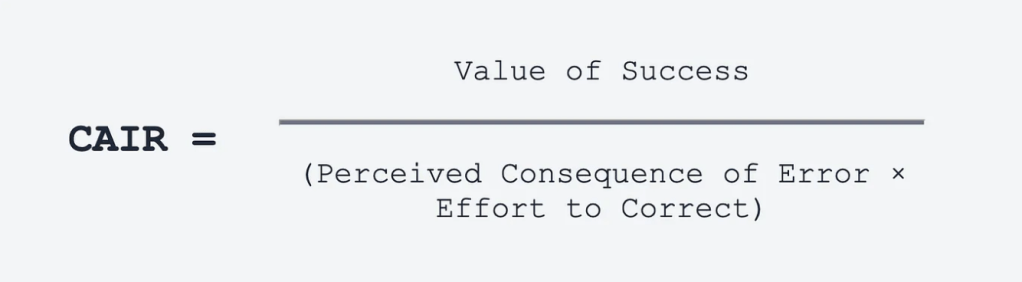
“CAIR” – Confidence in AI Results

The Hidden Metric That Determines AI Product Success, by Assaf Elovic

  • “Value: The benefit users get when AI succeeds.”
  • “Risk: The consequence if the AI makes an error.”
  • “Correction: The effort required to fix AI mistakes.”
  • “When CAIR is high, users embrace AI features enthusiastically. When CAIR is low, adoption stalls no matter how technically impressive your AI is.”

Five principles of CAIR optimization

  1. “Strategic human-in-the-loop (Optimizes all three variables)”
  2. “Reversibility (Reduces Correction)”
  3. “Consequence isolation (Reduces Risk)”
  4. “Transparency (Reduces Risk and Correction)”
  5. “Control gradients (Increases Value while managing Risk)”
    • “Start with low risk features and progressively offer higher value capabilities as confidence builds.”

Eternal Generation and LDS/Evangelical Dialog

Many of us evangelicals involved in the LDS/evangelical space of evangelism and dialog come from backgrounds where “Only Begotten Son” was taken to mean having unique consubstantiality without derivation (B. B. Warfield) or being incarnate and in the flesh (the early John MacArthur; Walter Martin, William Lane Craig).

The historic Christian doctrine of the Trinity is far greater. It holds that the Son was “begotten of his Father before all worlds.” This is also called eternal generation. This is the Nicene, Niceno-Constantinopolitan, Athanasian, Chalcedonian, Medieval, and Confessional Protestant view of the Son.

This doctrine (along with spiration) helps give definition to the distinctions between divine persons. It also further clarifies that the Trinity is not a mere “abstraction”, nor gas or force, nor akin to some LDS/platonic views of eternal law.

The doctrine of eternal generation is an excellent point of contrast with both early Mormonism (sans eternal progenitorship; favoring incarnational sonship) and later Mormonism (where all sons have fathers, and all fathers are sons).1 I submit that Mormonism’s rejection of eternal generation was its earliest expression of anti-transcendence. The doctrine is woefully missing from evangelical/LDS discussions, and more importantly, it is worth recovering for its own sake.

“Generation occurs also in the divine being. God’s fecundity is a beautiful theme, one that frequently recurs in the church fathers. God is no abstract, fixed, monadic, solitary substance, but a plenitude of life. It is his nature (οὐσια) to be generative (γεννητικη) and fruitful (καρπογονος). It is capable of expansion, unfolding, and communication. Those who deny this fecund productivity fail to take seriously the fact that God is an infinite fullness of blessed life. All such people have left is an abstract deistic concept of God, or to compensate for this sterility, in pantheistic fashion they include the life of the world in the divine being. Apart from the Trinity even the act of creation becomes inconceivable. For if God cannot communicate himself, he is a darkened light, a dry spring, unable to exert himself outward to communicate himself to creatures.”
—Herman Bavinck, Reformed Dogmatics: God and Creation, transl. John Bolt, and John Vriend (Grand Rapids, MI: Baker Academic, 2004), 2.308–310.

Online reading

Evangelical

  • Keith E. Johnson, “Is the Eternal Generation of the Son a Biblical Idea?,” The Gospel Coalition, June 18, 2012. Link.
    • If you only have time to read one thing, start here.
  • Josh Malone, “Begotten, Not Made,” Credo Magazine 10, no. 4 (2020). Link.
  • Scott R. Swain, “B. B. Warfield and the Biblical Doctrine of the Trinity,” Themelios 43, no. 1 (April 2018). Link.
    • Explains how B. B. Warfield’s backed off from the classic Nicene view.
  • Charles Lee Irons, “Let’s Go Back to ‘Only Begotten,’” The Gospel Coalition, November 23, 2016. Link.
    • Argues for a return in Bible translations to “only begotten Son” (instead of “one and only Son”).
  • John MacArthur, “Reexamining the Eternal Sonship of Christ,” Journal for Biblical Manhood and Womanhood 6, no. 1 (2001): 21-23. Link.
    • John MacArthur initially taught “incarnational sonship” (as did Walter Martin; the view that “only begotten” chiefly pertained to the condescension of Christ, his incarnation), but then returned to the doctrine of “eternal sonship.”

LDS reading

  • Blake T. Ostler, “The Idea of Pre-Existence in the Development of Mormon Thought,” Dialogue: A Journal of Mormon Thought 15, no. 1 (Spring 1982): 59–78. Link. See also chapter 12 in Line Upon Line.
    • The Book of Moses (LDS scripture) teaching a “conceptual blueprint” category of pre-existence, and not the eternal personalism that we see in the later Joseph Smith, or the spirit birth ideas of Brigham Young, Orson Pratt, or B. H. Roberts.
  • James M. McLachlan, “Is God Subject to or the Creator of Eternal Law?,” BYU Studies Quarterly 60, no. 3 (2021): 49–64. Link.
  • Samuel M. Brown, “Mormons Probably Aren’t Materialists,” Dialogue: A Journal of Mormon Thought 50, no. 3 (Fall 2017): 39–72. Link.
  • Lane Wolfley, “The Book of Mormon’s View of Godhead: Now It All Makes Sense” (presented at the Sunstone Southwest Symposium, 2006/2007). Audio. Transcript.
    • Essentially argues that incarnational sonship (i.e. “only begotten in the flesh”) was common currency in Smith’s theological environment. One could probably also correlate Smith’s early views on incarnational sonship to Adam Clarke’s commentaries.

Books

Evangelical

  • Scott R. Swain, The Trinity: An Introduction (Wheaton, IL: Crossway, 2020).
  • Scott R. Swain, The Trinity & the Bible: On Theological Interpretation (Bellingham, WA: Lexham Press, 2021).
  • Matthew Barrett, Simply Trinity: The Unmanipulated Father, Son, and Spirit (Grand Rapids: Baker Books, 2021).

See also

References

  1. The Ostlerian variation is interesting (as I understand it): an eternally emergent social trinity of three beings wherein the Father always gives to the Son the fullness of divine light, without beginning, although perhaps with a pause at incarnation. ↩︎

Michael Kruger on the Abuse of Matthew 18:15-20

Source: Michael J. Kruger. Bully Pulpit: Confronting the Problem of Spiritual Abuse in the Church (pp. 83-84).


While [Matthew 18:15-20] is an important passage for dealing with sins in a congregation, it isn’t exhaustive; it is not meant to address or solve every possible scenario. Unfortunately, sometimes it is treated like a universal cure that can be applied to every situation. Here are several important clarifications that prove to be especially relevant to abuse cases.

First, we must remember that Matthew 18 applies only to individuals who have been sinned against. It doesn’t just say, “If your brother sins,” but rather, “If your brother sins against you.” Thus, the passage doesn’t apply to every situation where one person might accuse another of sin. For example, if a member of a church staff has watched a pastor abuse other members of the staff, they are not obligated to go to that pastor directly. They can go straight to the elder board and report the bad behavior. In fact, 1 Timothy 5:19—“Do not admit a charge against an elder except on the evidence of two or three witnesses”—implies that such charges against an elder can be brought directly to church leadership. Abusive pastors are understandably eager to block this sort of complaint from ever making it to the elder board. So the pastor’s defenders or the pastor himself will often rebuke the accuser by saying something like, “Why didn’t you go to the pastor first as Matthew 18 requires?” The problem is that Matthew 18 doesn’t apply in this case.

Notably, just a few verses later, Jesus gives a positive example of direct reporting when one person sins against another: the unmerciful servant mistreating someone who owes him money (Matt. 18:21–35). When the other servants notice his bad behavior, they don’t confront him directly. Instead, the text says, “They went and reported to their master all that had taken place” (v. 31). The master did not say, “Well, have you confronted the unmerciful servant yourself?” No, in this case, the rule does not apply.

Second, even if the accuser should have followed Matthew 18 but failed to do so, that does not mean the elder board or other governing body should overlook the sins of the abusive pastor. Some abusive pastors treat Matthew 18 like Miranda rights—if the technical procedures aren’t followed, then they are unable to be prosecuted for the crime. But failing to follow Matthew 18 does not give someone a “get out of jail free card.” The church should still hold the pastor accountable for his abusive actions even if the accuser did not follow the right steps. Sure, the accuser’s failure to follow Matthew 18 should be addressed too, but there should be no attempt to make the two issues equally problematic, as if failing to follow Matthew 18 is equivalent to being an abusive shepherd.

Third, even if the accuser follows Matthew 18 and the abusive pastor admits some wrongdoing, that does not necessarily mean the behavior should not be reported to the church’s leadership. Some pastors want their victims to follow Matthew 18 so they can “resolve” the issue through a quick apology and move on without anyone else knowing. In other words, abusive pastors sometimes use Matthew 18 as a method of silencing the victims and keeping their track record of conflict under wraps.

But some behaviors are indeed serious enough that a member is justified in reporting it to the larger leadership body, even if the abusive pastor seems apologetic about it. Certainly, this includes blatant criminal behaviors where law enforcement needs to be involved. But a case can be made that a member could justifiably report spiritually abusive behavior too: verbal attacks, berating or humiliating a church member, threatening to fire an employee, and more. Bringing such behavior to the attention of those who are responsible for the oversight of that pastor’s ministry does not violate Matthew 18.

Fourth, some abuse cases are so severe that making the victim confront the abusive pastor privately would be irresponsible. For instance, if a pastor sexually groped a female staff member, it would be, in the words of McKnight and Barringer, “inexcusable and psychologically violent” to insist she meet with the perpetrator one-on-one. Indeed, no godly husband, having found out what happened to his wife, would force her back into a room alone with such a person under the pretenses of Matthew 18. Yet in the case of Bill Hybels, the female victims were scolded for not following Matthew 18 and meeting with Hybels privately.

Could those same concerns apply to certain cases of spiritual abuse? I think so. Again, one could understand how a husband might (rightly) refuse to allow his wife to meet alone with a pastor who has verbally intimidated and attacked her. As Lisa Oakley, an expert in spiritual abuse, has argued regarding Matthew 18, “When we get to a situation of spiritual abuse, there’s a mismatch of power. And, actually, trying to get people together in a room at the beginning is not something you would do with other forms of abuse.”

While the lines aren’t always clear, and there are inevitable gray areas that can be debated, we should remember that Matthew 18 is not a catchall passage that applies to every conceivable scenario.

Here’s the point: If a pastor is accused of abusive behavior, be wary if procedural issues become the biggest concern of all those involved.

Craig Carter on the Meaning of Biblical Monotheism

Source: Craig A. Carter. Contemplating God with the Great Tradition: Recovering Trinitarian Classical Theism (pp. 179, 181-183).


Throughout the Bible, we see a range of terms, which are hard to systematize, used to refer to a variety of spiritual entities who exercise various kinds of functions, including carrying out commissions, delivering messages, fighting as part of the heavenly army, governing aspects of creation, and ruling in various ways. Biblical monotheism does not deny the existence of these beings, and they all are called ʾĕlōhîm throughout the Old Testament.

Interestingly, Christian theology has typically used the term “angel” as an umbrella term for all of these entities that exist in the spiritual realm, both fallen and unfallen beings. The fallen angels usually tend to be called “demons,” which again functions as a broad category. But the terminology of the Hebrew Bible does not correspond to this use of the words “angel” and “demon.” In Hebrew, the word “demons” (šēdîm) is not used frequently and is not used of all fallen spiritual entities. It is, however, sometimes used when a particularly pejorative meaning is intended (e.g., Deut. 32:17; Ps. 106:37). But the pagan deities behind the idols used to represent them in paganism are often just referred to as ʾĕlōhîm rather than šēdîm, which could indicate that while all šēdîm are fallen ʾĕlōhîm, not all fallen ʾĕlōhîm are šēdîm. And we have already seen that Paul uses a variety of terms for ruling spiritual entities besides the term “angel,” a word he also knows and uses (2 Cor. 11:14; Gal. 1:8; 4:14). Some or all of the ruling entities to which Paul refers are fallen; that is, they are in rebellion against God and threats to us. If Paul were to write in Hebrew, he would undoubtedly call them ʾĕlōhîm, following Old Testament precedent…

What does biblical monotheism mean? I offer the following definition as a starting point.

Transcendent monotheism: This is the view that God is the transcendent Creator of all things. We see this view in the Bible, beginning in the Old Testament and continuing in the New Testament. It is also the view of the Nicene fathers and the trinitarian classical theism of the Great Tradition. This view is compatible with the existence of many levels and kinds of spiritual beings in addition to the LORD; what they all have in common is that they were all created by the transcendent Creator God, who is Yahweh, the God of Israel.

So that we can be as clear as possible about what is and is not being said here, let me offer some related definitions.

Pantheistic monotheism without polytheism: This is the view that there is only one God and this God is identical with the totality of all that exists. It can also be termed “philosophical monotheism.” We see this view in the writings of Baruch Spinoza.

Pantheistic monotheism with polytheism: This is the view that God is identical with all things but that certain forces of nature may be personified and regarded as gods. We see this view in Hinduism. We also see Augustine in The City of God criticizing some of the Platonist philosophers of his day for taking this position, as evidenced by their willingness to participate in the polytheistic paganism of their day, even though they professed a philosophical monotheism.

Polytheism: This is a view found in many areas of the world, in which there are many gods and even sometimes a “high god,” but all reality is not identified with God in an abstract manner. However, in many mythological cultures, such as the ancient Near Eastern ones surrounding Israel, the human, nature, and the divine all connect and interact with each other, which brings them close to pantheistic monotheism with polytheism.

Theistic personalism: This is the view that God is a person like us but different in degree. Many of the attributes of classical theism may be assigned to this type of God, but usually not simplicity, immutability, or impassibility. This view is like polytheism, but instead of a pantheon of gods, only one “high” God is worshiped, and only this one God is thought to exist. This view has made great inroads in modernity among evangelicals today.

Theistic mutualism: This is the view that God and the world coexist in a two-way relationship in which each affects the other for good or ill. This view is a type of post-Christian, neopaganism that is not the same as ancient mythological worldviews, but it shares one key point in common with them that makes it more like mythology than the biblical doctrine of God—namely, the rejection of transcendence. The soft version of this view, in which God sovereignly allows creation to cause change in him although he is not forced to do so, is increasingly popular among evangelical theologians, including conservative Reformed ones.

Elective monolatry: This is the view that there are many gods but that only one God is to be worshiped by our group. This is often held by polytheists who believe that their people or tribe should worship a certain god but that other tribes or nations should worship their own gods. This view was common in the Roman Empire of the New Testament period. It is really a subset of polytheism and not as close to ethical monolatry as the terminology might suggest.

Ethical monolatry: This is the view that there are many gods, but only one God is to be worshiped by anyone. This is the view of the Old Testament writings and of the Jews of the New Testament period. They held it to be morally wrong for anyone to worship any god but Yahweh, which of course made them seem extreme and arrogant to polytheists of all kinds. This view may be held without an accompanying belief in transcendent monotheism, but in that case, it lacks any solid theoretical foundation and can appear arbitrary.

In order to understand Isaiah 41–48 properly, we must see that ethical monolatry is compatible with transcendent monotheism, because pagan religions worship ʾĕlōhîm who are not Yahweh and are not worthy of worship. In fact, transcendent monotheism provides an ontological basis for ethical monolatry. While it is true that ethical monolatry is incompatible with scientific materialism, so is transcendent monotheism. Isaiah’s belief in a transcendent Creator rules out the possibility of any sort of pantheism, panentheism, theistic personalism, or theistic mutualism, because all of these doctrines view the divine as part of the cosmos rather than before and above the cosmos. It does not, however, rule out belief in many kinds of ʾĕlōhîm in addition to Yahweh.

Isaiah 41–48 teaches that only Yahweh is to be worshiped, not because Yahweh is the only ʾĕlōhîm that exists, but rather because Yahweh is the only ʾĕlōhîm who is worthy of worship. As the transcendent Creator, he is unique, and only the transcendent Creator should be worshiped.


“If any man thinks ill of you”

“Brother, if any man thinks ill of you, do not be angry with him; for you are worse than he thinks you to be. If he charges you falsely on some point, yet be satisfied, for if he knew you better he might change the accusation, and you would be no gainer by the correction. If you have your moral portrait painted, and it is ugly, be satisfied; for it only needs a few blacker touches, and it would be still nearer the truth.” – Spurgeon

“If my detractors only knew me better, then they would hate me even more.” – Nassim Nicholas Taleb (The Bed of Procrustes, p. 147)

“We ought not to be angry at [others] knowing our faults and despising us; it is but right that they should know us for what we are, and should despise us if we are contemptible. ” – Blaise Pascal (Pensees, Section 100)

(Hat tip to Luke and Craig for the quotes.)

Divine Incomprehensibility

“Great is the Lord, and greatly to be praised, and his greatness is unsearchable.”
(Psalm 145:3)

“Who has known the mind of the Lord, or who has been his counselor?”
(Romans 11:34)

That God is incomprehensible means that only God knows God unmediated, immediately, and completely.

This is a foundational doctrine, not a concession we make when we punt.

It’s the beauty of what everything is grounded on. We can only know God because he self-discloses. He reveals himself.

He doesn’t speak across to us. He kindly speaks down to us with analogical categories.

God alone “dwells in unapproachable light, whom no one has ever seen or can see.” (1 Timothy 6:16), yet that light illuminates and gives meaning to all else.

The same holy fire that can destroy us, that we cannot grasp or contain or manipulate, also provides life and light and warmth and sight for creatures.


“The heavenly begetting is more incomprehensible than your own, to the same extent that God is harder to trace out than Man.” (Gregory of Nazianzus)

“If you make its incomprehensibility a ground for denying the fact, it is high time you ruled out as non-existent a good number of things you do not understand, the chief of which is God himself.” (Gregory of Nazianzus)

“Like the sun you cannot look at God without going blind. And yet, we cannot see anything apart from the sun illuminating our way.” (Matthew Barrett)


Human incomprehensibility

“The human person is made in the image of God, who is incomprehensible, and so shares an element of incomprehensibility on a creaturely level.” (Robert Letham)


My 10-year-old daughter knows me, but she does not comprehend me. If creation has its own incomprehensibility (Proverbs 30:18-19), how much more does God himself (Psalm 139:4-6)?

There is a worshipful humility in marveling at such depth.

“Oh, the depth of the riches and wisdom and knowledge of God! How unsearchable are his judgments and how inscrutable his ways!” (Romans 11:33)


Incomprehensibility as the infinite depth of divine rationality

“If we demand comprehensive understanding of God and his ways, then we deny that he is God, the incomprehensible one. There is a mystery to the incarnation, but not irrationality; it is an infinite depth of divine rationality that we cannot plumb, yet can receive by faith.”
– Joel R. Beeke and Paul M. Smalley, Reformed Systematic Theology: Volume 2: Man and Christ (Wheaton, IL: Crossway, 2020), 843–44.


John Owen: “unto this loss do I desire to be brought”

“I know that in the contemplation of [the incarnation], it will quickly overwhelm our reason, and bring our understanding unto a loss:

“but unto this loss do I desire to be brought every day;

“for when faith can no more act itself in comprehension, when it finds the object it is fixed on too great and glorious to be brought into our minds and capacities, it will issue…in holy admiration, humble adoration, and joyful thanksgiving.

“…In and by its actings in them does it fill the soul with ‘joy unspeakable, and full of glory.’”

– John Owen, Meditations and Discourses on the Glory of Christ (link)

The Outward and Inward Call

God’s outward call says, “Come, believe, and find rest in Christ!”

God’s inward call brings a subconscious change of heart by the Holy Spirit. God opens the eyes in a person to assuredly receive the word.

This distinction doesn’t solve the mystery, but it further describes it.

God genuinely offers, beckons, beseeches through his word:

“Therefore, we are ambassadors for Christ, God making his appeal through us. We implore you on behalf of Christ, be reconciled to God.”
– 2 Corinthians 5:20

Yet there is also a kind of “drawing” that always results in coming to the Son:

“No one can come to me unless the Father who sent me draws him. And I will raise him up on the last day… This is why I told you that no one can come to me unless it is granted him by the Father.”
– John 6:44,65

Hence we pray, “Lord, open their eyes!” And we preach, “Behold what God has revealed!”

Five-Point Trinitarianism

  1. There is one God.
  2. Each divine person is God.
    The Father is God.
    The Son is God.
    The Spirit is God.
  3. Each divine person is not the other.
    The Father is not the Son.
    The Son is not the Spirit.
    The Spirit is not the Father.
  4. Each divine person is distinguished by eternal relations of origin.
    The Father eternally begets the Son.
    The Son is eternally begotten.
    The Spirit eternally proceeds from the Father and the Son.
  5. How God acts in history corresponds to all the above.

Sophistry

When minor things are used to mask major things.

When words are technically true, but substantially misleading.

When true information is used to give false impressions – by design or cowardice.