We already live in Narnia

We live in a universe where:

A giant black hole sucks the equivalent of a star every day.

Humans argue morality and the meaning of existence.

The news showcases great injustices.

Men courageously die in battle.

Lovers romance each other.

Parents conceive new life.

Mothers carry little people in their wombs.

Mountains tower over us with majestic beauty.

People dream.

Christians sing to the Creator who spoke everything into existence.

We already live in Narnia.

“There are no ordinary people. You have never talked to a mere mortal. Nations, cultures, arts, civilizations – these are mortal, and their life is to ours as the life of a gnat. But it is immortals whom we joke with, work with, marry, snub and exploit – immortal horrors or everlasting splendors.” – C.S. Lewis

Angels peer into our world and are enthralled by it.

My friend Luke shares:

“Nusery tales only echo an almost prenatal leap of interest and amazement. These tales say that apples were golden only to refresh the forgotten moment when we discovered that they were green. They make rivers run with wine only to make us remember, for one wild moment, that they run with water!” (Quote from the essay “The Ethics of Elfland,” which is chapter 4 in “Orthodoxy.”)

Jesus on strategic spirituality

  • Don’t judge (then you won’t be judged)
  • Settle accounts early (then you’ll have inside help)
  • Give to the poor (then you will be rich in heaven)
  • Take the back seat (then others will honor you)
  • Clean the inside of your cup (then the outside will be taken care of)
  • Don’t waste time with swine (then you won’t be trampled)
  • Be a eunuch (then you won’t have marriage woes)
  • Be faithful with the small (then you’ll be over the large)
  • Lose your life (then you’ll gain it)
  • Leave everything for Jesus (then you’ll have ten times more)

“No one ever spoke the way this man does.” (John 7:46)

A bright room still visible

quilted white comforter

The relative inaccuracies of Bible transmission and translation are like:

  • dust mites in the air
  • angled blinds
  • smudges on glass

… that a bright beam of daylight encounters when bursting through a window.

The room is still visible. The objects in the room are discernible. You can still walk around. You can still see.

You would never say: I’m blind, I’m blind! Oh, the dust mites!

Christians dispositions we wrestle with during COVID-19

  • We are eager to obey the government in both its demands and requests (1 Peter 3:13-17).
  • We are eager to love our neighbors by not being reckless (Mark 12:31).
  • We are eager to love our brothers who are starving for fellowship and dangerously lacking encouragement (Hebrews 3:13-14).
  • We are eager not to act in the fleshly spirit of rebellion or resistance (Romans 13:2).
  • We are eager to obey God when it conflicts with obeying man (Act 5:29).
  • We are eager to have a clear conscience (Romans 14:22).
  • We are eager to live “a peaceful and quiet life, godly and dignified in every way” (1 Timothy 2:2).
  • We are eager not to make a habit of not gathering as Christians (Hebrews 10:25).

God-centered eternal progression

Will we become “like” God in heaven and the resurrection? Will we progress? Will we be bored?

Let me contrast two views that I disagree with, and then describe the view (#3) that I take:

View #1

woman standing at escalator

The view of Brigham Young and Wilford Woodruff. In this view all the gods always progress in all of their attributes. And by the time we get to know what God knows now, we will have since then learned more. This is like an escalator. We travel upward, and by the time we arrive where God is now, he will have moved forward. Bruce McConkie condemned this view as a deadly, damnable heresy.

View #2

brown and white mountain under blue sky during daytime

The view of Orson Pratt, which was later championed by Joseph Fielding Smith and Bruce McConkie. These said that all the exalted gods are equal in knowledge and power, cease to progress in their attributes. This view is like joining all the gods on top of a plateau. Brigham condemned this view and insisted that God is still learning.

These gods only progress in their “eternal increase”, that is, in their children or dominions. Sort of like a cosmic MLM.

View #3

silhouette photo of man on cliff during sunset

God-centered eternal-progression. Christians have an infinite God that has always known everything. God isn’t progressing in knowledge or power. He has never learned. His people grow forever in the enjoyment and capacity to enjoy his kindness. They never “max out” in the knowledge of God, since God is infinite.

Paul says in Ephesians 2:7 that Christ has raised us, “so that in the coming ages he might show the immeasurable riches of his grace in kindness toward us in Christ Jesus.“ Paul prays in Ephesians 1:18 that believers would have “the eyes of your hearts enlightened, that you may know what is the hope to which he has called you, what are the riches of his glorious inheritance in the saints, and what is the immeasurable greatness of his power toward us who believe.”

So I will never get to the last page of the last book in the library of God’s knowledge and grace and say, “That’s it. That’s all there is to know.” His kindness and knowledge and power are “immeasurable” and “unsearchable” (Romans 11:33).

I like the way John Piper put it:

“In Christ the best is always yet to come. Always. No exceptions. Forever.”

Eternal progression of finite creatures who forever progress in the enjoyment of the kindness of an infinite God. All in the context of a new heaven, new earth, new physical resurrection body, new humanity, new community. With songs and culture and food and ethnic people groups and personality and relationships and land and property and dominion and responsibilities and work and governance.

“His plan is for us to develop, as apprentices to Jesus, to the point where we can take our place in the ongoing creativity of the universe.” (Randy Alcorn, “Heaven“)

And unimaginable things that we can’t even dream of.

Kwaku/Aaron 2020 Debate Review (Part 1)

On March 6, 2020 Kwaku El and I debated on the topic of “Is Jesus Enough?” at Utah Valley University. Our subtopics were:

  1. Is salvation by faith alone?
  2. Was there a Great Apostasy?
  3. Are families forever?

Part 1 will of this review be a high-level overview of the debate and a response to Kwaku’s latest video wherein he depicts me as Hitler.

Part 2 will dive more into the content of the debate, with a focus on the topics we had agreed to cover.

Continue reading “Kwaku/Aaron 2020 Debate Review (Part 1)”

Greeting is serious business

It is good to show familial affection for believers and neighborly love to unbelievers in a distinguishable and meaningful way.

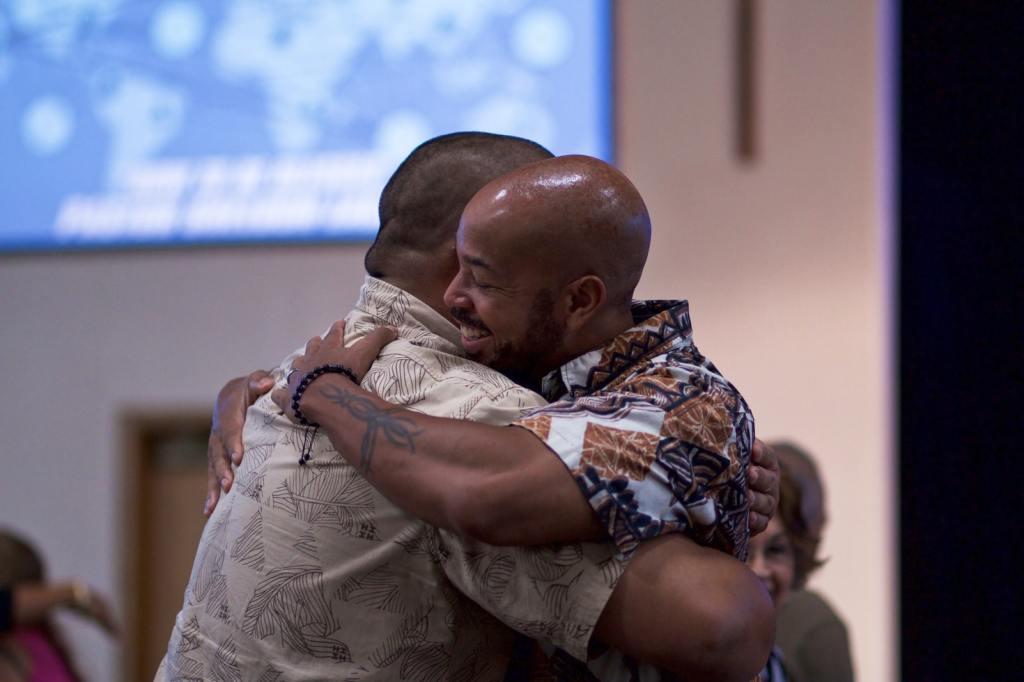
Our theology and practice of greeting brothers in Christ is surprisingly relevant. We are called in Scripture to give brothers a “holy kiss.” Try approaching it seriously. It’s a real command. We are to greet fellow disciples of Jesus with warm affection. To receive, welcome, and host them with special kind of familial love.

When my coworkers see me encounter a believer on the way (walking across the street) to lunch, they seem me jump up, excited.

I don’t hug my coworkers. I hug brothers.

Around 2001 I started saying, “Grace and peace!”, to brothers in Christ. It might sound awkward or unusual to modern ears, but so what? I say explicit things like, “Greetings in Christ” or “It’s good to see a brother” when believers come through our church doors.

We need to find some way to essentially do this. It’s awkward at first. Get over it. It’s Biblical. I’m not weird. Our culture is weird.

When you make a practice of especially greeting brothers in Christ, of giving them a clear affirmation of brotherhood upon first seeing them or departing from them, then you will develop over time a different but still genuine way of graciously greeting *unbelievers*.

The former is the greeting of familial love (Romans 16:16), the latter is a greeting of neighborly love (Matthew 5:47).

One benefit of developing a theology and practice of special greetings and conversational warmth for brothers is that you can then act in clear-minded conscience when you start a conversation with an unbeliever. You can send clearer signals.

You can put yourself into a categorical mode of thinking about the relationship. You are not treating an unbeliever like spiritual family.

Over time, unbelievers will see you act with a warmth toward believers that you don’t have with unbelievers. And yet they will know you have been courteous or gracious with them.

Greeting is serious business:

  • Jesus wants us to greet unbelievers. (Matthew 5:47)
  • The disciples were to greet believers who hosted them as emissaries of Christ. (Matthew 10:12)
  • We are warned against a fleshly enjoyment of greetings (Matthew 23:7, Luke 11:43)
  • The angels greet. (Luke 1:28)
  • Paul greets sibling in Christ by name. (Romans 16:3-15)
  • Believers are commanded to greet each other with a “holy kiss”. (Romans 16:16, 1 Corinthians 16:20, 2 Corinthians 13:12, 1 Thessalonians 5:26)
  • We are commanded to *avoid* greeting false teachers. (2 John 1:10)

See also

Front-loading our ecclesiology

I mentioned on a panel yesterday “front-loading ecclesiology” in Utah. I worry that I was not clear or helpful in tone. Here is what I’d like to more carefully say:

All true Christians belong to the universal church. But meeting for small group or coffee over the Bible does not suffice to constitute a local church. A church regularly assembles around the word and the Lord’s Supper, has its own government, and is the chief community in which one practices the “one another” commands of the New Testament.

We have these beautiful commands in the New Testament to put up with, tolerate, love, be kind to, teach, sing with, and forgive one another. We can’t obey these without getting consistently close enough such that fallen sinners can relationally hurt us.

Even though ex-Mormon Christians in Utah (and in general, American evangelicals!) are cautious and sensitive about membership, committing, being accountable to a church community, we owe it to them to be up front about the reasonable Biblical expectation of making a conscious and community-affirmed decision to belong to a local church.

We are to have the kind of community where those unrepentant, yet who claim to be fellow Christians, can be “purged” from the community (1 Corinthians 5). There is an expectation that true believers “listen to the church” (Matthew 18), lest they be treated (even if courteously and graciously) as unbelievers. My point here isn’t about excommunication. It’s that such Biblical ecclesiology (doctrine and practice of the church) can’t even happen if believers don’t form into local churches and recognizably belong to them. This is at odds with endless wandering or church-hopping or merely watching YouTube sermons.

Church membership, which at least means knowing who is consciously committed and mutually affirmed in your local church as fellow believers in good standing, is a healthy and natural practice of this. The formalities are only important inasmuch as they help give expression to it.

We want to incubate, mentor, and disciple believers in the local church — not simply say hi to them every so often! We want believers to grow and become stable oak trees of influence, wisdom, and encouragement to the next generations. This growth doesn’t happen if one is detached from the local church.

So let’s be open about the doctrine and practice of the church early on. Even as we have to be meek, gentle, and patient for years with believers who don’t put both feet in. But let’s be clear about it. This will serve the church, help believers grow, and most importantly honor Christ.

This is the attitude I want to have in engaging issues like this:

“The wisdom from above is first pure, then peaceable, gentle, open to reason, full of mercy and good fruits, impartial and sincere. And a harvest of righteousness is sown in peace by those who make peace.” (James 3:16-17)


Addendum. Questions for professing believers who are not attached to a local church:

  • Which local pastors do you submit to? (Hebrews 13:17)
  • Which ones are accountable for overseeing you in the faith?
  • Which body would first excommunicate you if you reached the end of the Matthew 18 process, or were identified (hypothetically) as an unrepentant adulterer (1 Corinthians 5)?
  • Which such community affirms and gladly receives the credibility of the profession of your faith?
  • With which primary body are you practicing the “one anothers” of the New Testament?

If none, then you need to find a church and explicitly let its members and leadership know that you are committed to them in this fashion.