Glorious Distinction: Justification Secures Transformation But Is Not Itself Transformative

In Romans 3-8,10, the justification spoken of is a singular legal and forensic event. Believers are counted righteous, imputed with the righteousness of Christ, reckoned with the one act of Christ’s righteousness. God looks them in the eye and says, “I love you, and I have counted your sin to Christ, and counted his perfect righteousness to you.” Even though Christ is sinless, he is counted as a sinner on my behalf. Even though I am not righteous, he counts me as righteous (cf. 2 Corinthians 5:21). While Paul looks backward to this event of justification, and continuously and progressively revels in it, it is an already complete, permanent legal state of grace. It is something we stand on, and since it is the righteousness of Christ we are legally being credited with, it is not something that we get more of (because Christ’s righteousness is already complete). We have received the “completely not guilty” and “completely righteous” verdict, once and for all. I am not counted less guilty the next day or more legally righteous the next week. In this sense, I am equally justified with all believers in Christ, and equally so throughout all my post-conversion days.

In Romans 2:13 I would argue that the term “justified” is referring to vindication at final judgment. This also is a legal declaration, but in this case really is pointing to moral transformation that has happened within me. I think this is more of the sense that we see in James 2:21-26 as well. Declarative vindication of inward transformation. On a related note, I personally reject the popular Protestant wholesale hypothetical reading of Romans 2. I don’t think it is necessary for preserving the doctrine of justification by faith apart from works in subsequent chapters.

What is interesting is that neither of these usages of “justified” entail any kind of transformation in the act of justification itself. There is no doubt transformation by the Spirit, i.e. circumcision of the heart, in a justified person, but just as the “guilty” or “not guilty” verdict in a courtroom doesn’t behaviorally transform one into a guilty or righteous person, so also justification itself is not an act of transformation. Hence the strong justification/sanctification distinction historic Protestants make. Inseparable but distinct.

These could be two of the most important paragraphs on the gospel I have ever written, so please read them closely:

The distinction is good news because it means Christ justifies the ungodly by faith, i.e. counts the ungodly as godly, counts sinners as sinless, counts the unrighteous as perfectly righteous. The inseparability is good news because it secures my verdict at final judgment where my heart-orientation and secret works will be courtroom evidence of who I am.

In the end, only those justified by faith apart from works of the law truly become doers of the heart of the law. It is one of the most life-or-death ironies in the universe, which some will celebrate forever in heaven, and others will curse forever in hell: If you work for forgiveness to preserve the necessity of holiness, Christ will neither forgive you nor make you holy. Yet if you stop working for forgiveness, and instead receive it as a free gift, God both forgives you and necessarily and inevitably makes you holy.

“He will render to each one according to his works: to those who by patience in well-doing seek for glory and honor and immortality, he will give eternal life; but for those who are self-seeking and do not obey the truth, but obey unrighteousness, there will be wrath and fury.” (Romans 2:6-8)

“Therefore, since we have been justified by faith, we have peace with God through our Lord Jesus Christ. Through him we have also obtained access by faith into this grace in which we stand, and we rejoice in hope of the glory of God.” (Romans 5:1-2)

“Now to the one who works, his wages are not counted as a gift but as his due. And to the one who does not work but believes in him who justifies the ungodly, his faith is counted as righteousness, just as David also speaks of the blessing of the one to whom God counts righteousness apart from works: ‘Blessed are those whose lawless deeds are forgiven,and whose sins are covered! Blessed is the man against whom the Lord will not count his sin.'” (Romans 4:4-8)

Is this grace too good to be true? Can it be, Lord, can it really be?

Jesus explains the unbelief of Judas by implying that he wasn’t drawn by the Father or granted to come to the Son

Another core text of Calvinism besides Romans 9 and Ephesians 1 is John 6, starting at v. 37. Here is how I would summarize a Calvinist reading of the passage, heavily borrowing much language from the chapter itself. Before you read my interpretation though, please listen to the scripture itself.

Continue reading “Jesus explains the unbelief of Judas by implying that he wasn’t drawn by the Father or granted to come to the Son”

Romans 9 – The Unstoppable Purpose of God in Unconditional Election

The following are notes from a Reformation Sunday sermon (MP3) I preached last year on Romans 9:1-23 at a church in Santaquin, UT. I predict that what I will promote here is, for most of you, completely foreign to the worldview that you were brought up with. I only ask that you make a valiant effort at understanding the text itself before approaching the issues using traditional philosophy.

I also want you to know that I have an emotional and spiritual connection with this text, for a number of reasons. You see, Romans 9 and I have a history together. It was a source of controversy in my college days. It was something I originally vehemently disagreed with. It was something that, once it clicked, was hard for me to handle with maturity. But it was also something that, in the long-run, explosively enlarged my view of God and catapulted me forward with a confidence that God was far bigger than I ever imagined. A big reason why I am in Utah today (and not closer to family on the East Coast) is that I believe that the God of Romans 9 can effectively call people to himself, including Mormons.

Continue reading “Romans 9 – The Unstoppable Purpose of God in Unconditional Election”

D.A. Carson on Some Different Ways the Bible Speaks of the Love of God

Excerpt from D.A. Carson’s The Difficult Doctrine of the Love of God, 16-21.

(1) The peculiar love of the Father for the Son, and of the Son for the Father. John’s Gospel is especially rich in this theme. Twice we are told that the Father loves the Son, once with the verb ἀγαπάω (John 3:35), and once with φιλέω (John 5:20). Yet the evangelist also insists that the world must learn that Jesus loves the Father (John 14:31). This intra-Trinitarian love of God not only marks off Christian monotheism from all other monotheisms, but is bound up in surprising ways with revelation and redemption…

(2) God’s providential love over all that he has made. By and large the Bible veers away from using the word love in this connection, but the theme is not hard to find. God creates everything, and before there is a whiff of sin, he pronounces all that he has made to be “good” (Gen. 1). This is the product of a loving Creator. The Lord Jesus depicts a world in which God clothes the grass of the fields with the glory of wildflowers seen by no human being, perhaps, but seen by God. The lion roars and hauls down its prey, but it is God who feeds the animal. The birds of the air find food, but that is the result of God’s loving providence, and not a sparrow falls from the sky apart from the sanction of the Almighty (Matt. 6). If this were not a benevolent providence, a loving providence, then the moral lesson that Jesus drives home, viz. that this God can be trusted to provide for his own people, would be incoherent.

Continue reading “D.A. Carson on Some Different Ways the Bible Speaks of the Love of God”

Fire in my bones for the God of glory

Read with Our God playing. To the God worth declaring.

Let it echo across the Salt Lake Valley
Let the people of the true Jesus rally
Let the timid see a glow and feel the heat
As the word of the Lord is preached

God is too great to keep Salt Lake placid
Yet God is too kind for speech like acid
Jesus Christ, full of grace and truth
Fit both to whisper and to preach

Fire in my bones for the God of glory
Blood on my hands if I don’t share the story
Beats in my heart for sheep with no shepherd
Today is the day to preach

Forgiving Grace: If I Can’t Have It Now, I’ll Never Have it

Read with How He Loves playing. To the God of the brokenhearted in Romans 4:5.

The grace I need is deeper than the grace they have
I can’t wait around to be forgiven
I need forgiveness today
Actually, this second

Don’t meet me at my weakness, and do the rest
No, go underneath it
To the bottom
And do it all

Don’t tell me to be what I never will be in this life
And then tell me that afterward it will be OK
No, I want more than “OK”
And I want it now

I need grace after all I can do to screw up
My opportunities
My relationships
My heart

Regard me as something that I’m not
Treat me like I’m already everything
You ever wanted me to be
And then change me

I don’t want the prospect of your forgiving love
I want the reality
Today
Now

The Angels Gasp Twice

Reading accompanied by Kevin MacLeod’s Snowdrop

When the sons of Adam said of the Most High
He perhaps sinned“, the angels stood by
And gasped in horror, drawing their swords
But the Lord of lords, He commanded pause

“Though the sons of man fall like the sons of God,
This time I curse a lightning rod
My justice will come, my fury come fierce
But first my Son I plan to pierce”

Now angels with strange sweet delight
Gasp at the shocking, awesome sight
Of wretches rescued from blasphemy
Gladly singing Holy, Holy, Holy

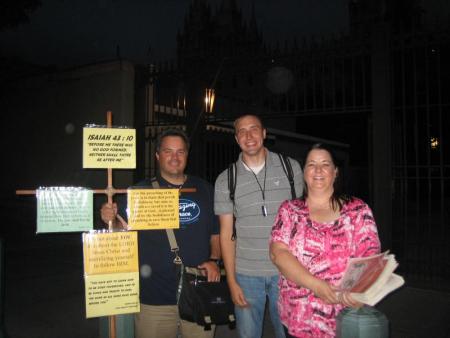
I Love Evangelism at Temple Square

I love the normal downtown nights
No Conference crowds or Christmas lights
More regular people willing to talk
More college students on casual walks

Less screeching King James callous men
Less mocking via theatric sin
Less garment-waving, stringed book throwing
More heart ache pleading word seed sowing

Having hearty, lengthy, truth-filled talks
Is what I yearn for, what I want
With hearts and Bibles together opened
To words sweeter than honey

I love praying for a conversation
And going home with exclamation
Seeing God in every situation
Advancing His good reputation

I Hate Winter

Winter depression
Sinus infection
Chill in the air
Stuck in my lair

Freezing two feet
Too hot under sheets
My lungs feeling old
Master bedroom so cold

If Spring was a sprinter
Outrunning every cold Winter
I wouldn’t be writing
This poem