
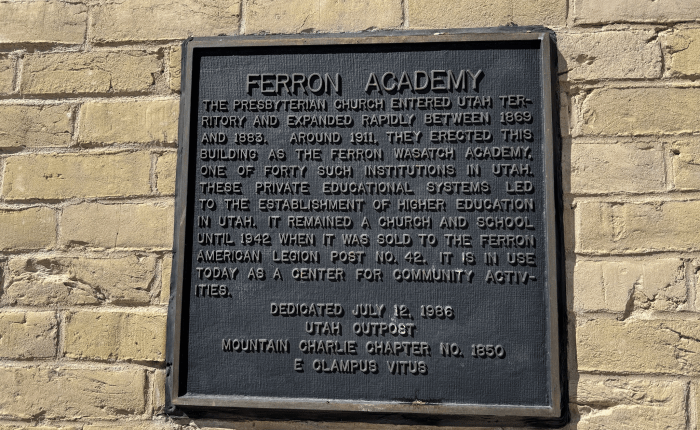
Source: October 1996 Blazer. Color pictures not in the original.
UTAH’S FRONTIER COMMUNITIES were overwhelmingly Mormon. But in the 1860s Episcopalian congregations were founded in several Utah towns. Especially after 1869, when the transcontinental railroad made western travel easier, other sectarian influences were felt in Utah as well.
One fall a caravan of Christian preachers came through Ferron, Emery County, for instance. The locals called these itinerant ministers “wagon missionaries.” Some Ferronites obviously attended these outdoor meetings, or they would not have been able to recall that a few of the tenets preached there were “radically different” from Mormon beliefs.
Presbyterian missionary efforts tended to focus on education rather than proselyting. Beginning in 1869 Presbyterians built church-school complexes in 33 Utah towns. By 1883, while Presbyterian membership rolls listed only 350 names, 1,789 students were attending Presbyterian grade schools in Utah.
After 1883 the Utah Presbyterian mission did little expanding. One exception was Ferron. In 1905 national Presbyterian leader Sherman Doyle gave a new generation of missionaries this call to arms: “The people are there [in Utah] by the thousands. They are in ignorance, in superstition, and in irreligion…in the spirit of the master let us be willing to spend and be spent in winning the souls of these deluded thousands to his cross and his crown.”
As a consequence, two missionaries, Tom Jones and Mac McKenzie, came to Ferron to try to win over Mormons to a more traditional Christian gospel. They doubled as carpenters, erecting a two-story frame church and schoolhouse. Jones and McKenzie stayed on to become established citizens, serving their church without pay while building many of the substantial frame and brick homes that area settlers were becoming able to afford.
In 1908 the First Presbyterian Church of Ferron bought two lots and began work on a brick complex to consist of a church, school, and manse. The Mormons proved less susceptible to conversion than expected, and funding to complete the buildings did not materialize until 1910. But from that year on the Presbyterian church served as a cultural center in Ferron: home to drama and musical events, a school for grades 1-8, and for a time the town’s only free lending library. Teachers at the school were mostly young women who lived on the second floor of the manse.
Ferron’s local schools were run by the LDS stake and wards. In 1890 the Emery LDS Stake opened a high school in nearby Castle Dale. Ferron Ward had its own high school, but for at least one year its senior class consisted of only two students. One bragged he was the class valedictorian and his sister was its salutatorian.
With no alternative to the Mormon high school, which naturally served as unofficial dating bureau, sometime before 1914 Presbyterians opened a branch of the Mount Pleasant Wasatch Academy in Ferron. Because of its superior, college-trained faculty and the specialized music and art courses available, many Mormon families sent their children to this academy. The tradition continued even into the early twenties, when the state mandated free secular schools in every town and a public high school was built.
In the meantime, the Presbyterian school system made it possible for Protestant children to obtain a complete education without leaving the state. They could attend elementary and middle grades at their own church school in Ferron, high school in either Ferron or Mount Pleasant, and college at Westminster in Salt Lake City. The Wasatch Academy in Mount Pleasant as well as Westminster College thrive to this day.
But by 1942 most of Utah’s Presbyterian schools had served their purpose. They may not have greatly enlarged the church’s membership rolls, but they had been a force in the establishment of free, public education throughout the state and had served as a model for the new secular system. In addition, they had enriched the cultural landscape of 33 communities, helping Ferron in particular to evolve from a 19th-century frontier outpost to a cultured 20th century town.
Sources: Wanda Snow Peterson, Ferron Creek: Its Founders and Builders (Bountiful, Utah: Horizon Publishers, 1989); First Presbyterian Church of Ferron Nomination Form, National Register of Historic Places, Preservation Office, Division of State History.
 I Am Aaron Shafovaloff