
Source: The Evangelist, October 26, 1899, p. 8. Link.
Somewhat over a year ago, an appeal was made by the American Tract Society for special aid in behalf of its colportage work in Utah. In response to that appeal, several Christian Endeavor Societies united in furnishing the funds necessary for the equipment of a Gospel colportage wagon. Other help was generously given, and the result of this united effort is thus expressed in the last annual letter of our valued colporter, Mr. George D. Peacock.
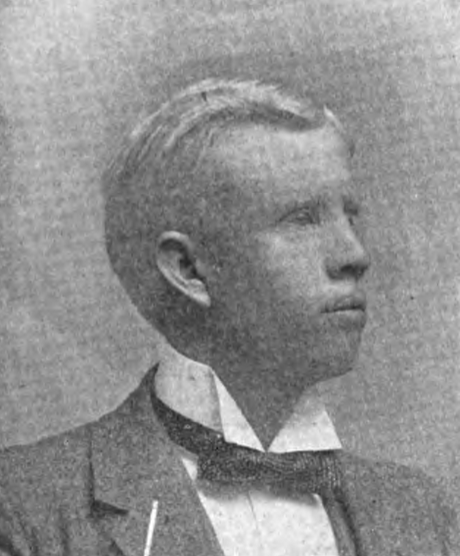
“The colportage wagon, which is fitted out with mattress, cooking apparatus, and utensils, tent and such other conveniences as go to make up a first-class traveling equipage, will greatly facilitate carrying on our work. Heretofore much of my work has been along railroad lines, and I have been greatly hampered for lack of facilities for reaching the ‘out-of-the-way places.'”
By means of the colportage wagon, Mr. Peacock has traveled hither and thither, scattering tracts, leaflets, and books, and preaching the word of truth wherever opportunity has offered. Meantime he has been busy with the camera, and the accompanying pictures are but a few of many that have been taken to illustrate his work for the Tract Society.

As to his methods Mr. Peacock writes:
“Until within the last six months, my work has been along railroad and stage coach lines and places easy of access. The same is true of all missionaries at work in Utah, which means that a large percentage of the people living in remote parts have not Gospel privileges nor have they been supplied with Bibles and Christian literature.
“I opened my first campaign with the new colportage equipage the first of last May, in company with the Rev. Dr. Wishard, the Rev. E. S. Anderson, and the Rev. G. W. Martin.
Our Gospel party set out from Salina, Utah, on a bright May morning, and as we had planned to open our campaign at St. George, Utah, a distance of two hundred and fifty miles, had to be covered. I think words are inadequate to describe the wild, barren and isolated regions through which one travels en route to the ‘Dixie of Utah.’ The St. George road traverses a few productive valleys, then over that great Tushar range whose summit towers up twelve thousand feet above sea level, through the narrows of Clear Creek Cañon, with perpendicular cliffs a thousand feet high on either side, then over a dreary desert waste, and at last over a volcanic range, from whose summit a rapid descent of thirty-three hundred feet in a distance of four miles, brings us to St. George.
“In two days our tent is pitched and seated and everything ready for a series of meetings to last through five weeks. By this time, our plan was discovered by the Mormon officials and we were written up in an editorial in the Deseret News (the church organ). We were soon followed by the First Presidency and some other officials of the Mormon Church, who came down to Southern Utah, to keep their brethren from ‘going astray,’ as they called it. They did not hamper our work, however. Our tent meetings were a success beyond all expectation. Great crowds came night after night, and joined heartily in the singing of Gospel hymns.
“I went on day after day, with my house-to-house visitation, everywhere distributing tracts and bound volumes, praying with the people, and encouraging them to continue in attendance at the meetings.
“I had been through Southern Utah on a colportage tour in the autumn of 1897. St. George was not a strange place to me, and many of the people remembered me, giving assurance that the good books distributed before had influenced them for good.
“Southern Utah, south of the ‘great basin rim,’ has an elevation of twenty-seven hundred feet, and is extremely hot, dry, and sandy; the valleys are narrow and deep; perpendicular walls of red sandstone and black basaltic rock rise up to great heights on every hand. Extinct volcanoes are numerous, and the cragged lava ridges run in every direction.
“The water is highly impregnated with minerals; the supply very inadequate for irrigation. It is amazing how people find a subsistence in such a country. Extreme poverty, ignorance, and immorality are very prevalent. Wine-drinking is indulged in to an appalling degree. Dancing, card-playing, and cigarette-smoking are the favorite ‘pastimes.’
“The first of last July found me in Parowan, Iron County. I left there on the morning of July 4 for Salina, Sevier County. The distance is one hundred and twenty miles, and I was three days on the road.
“One hundred miles of my route lay right along the west bank of the Sevier River. This river traverses several fertile valleys, separated now and then by chains of mountains, through which the Sevier River has cut deep cañons, whose precipitous walls on either side were several hundred feet high.
“There are a great many ranches and several little villages interspersed throughout the whole extent of the Sevier Valley. The people occupying these villages and ranches are nearly all Mormons. They are very illiterate and superstitious, as well as indolent and negligent in all their domestic affairs. They have but little money, and still less of the comforts of life. One does not have to ask these people if they are educated, if they like books, and if they love the flag. Their very houses—houses, for they cannot be called homes—and their surroundings, are sure indications of their condition.
“I visited many of these ranches. Many of the people were entirely without religious reading, and but few of them had even a Bible or a piece of a Bible.
“Such is the country and such is the condition of the people through Southern and Eastern Utah. Blessed work that will carry the Gospel in the ‘printed page,’ into these homes, that it may remain there permanently to accomplish that whereunto it has been sent!”
Since writing the above, Mr. Peacock has been actively engaged in the work of distributing Christian literature through Utah.
From The Messenger, courtesy American Tract Society.
 I Am Aaron Shafovaloff